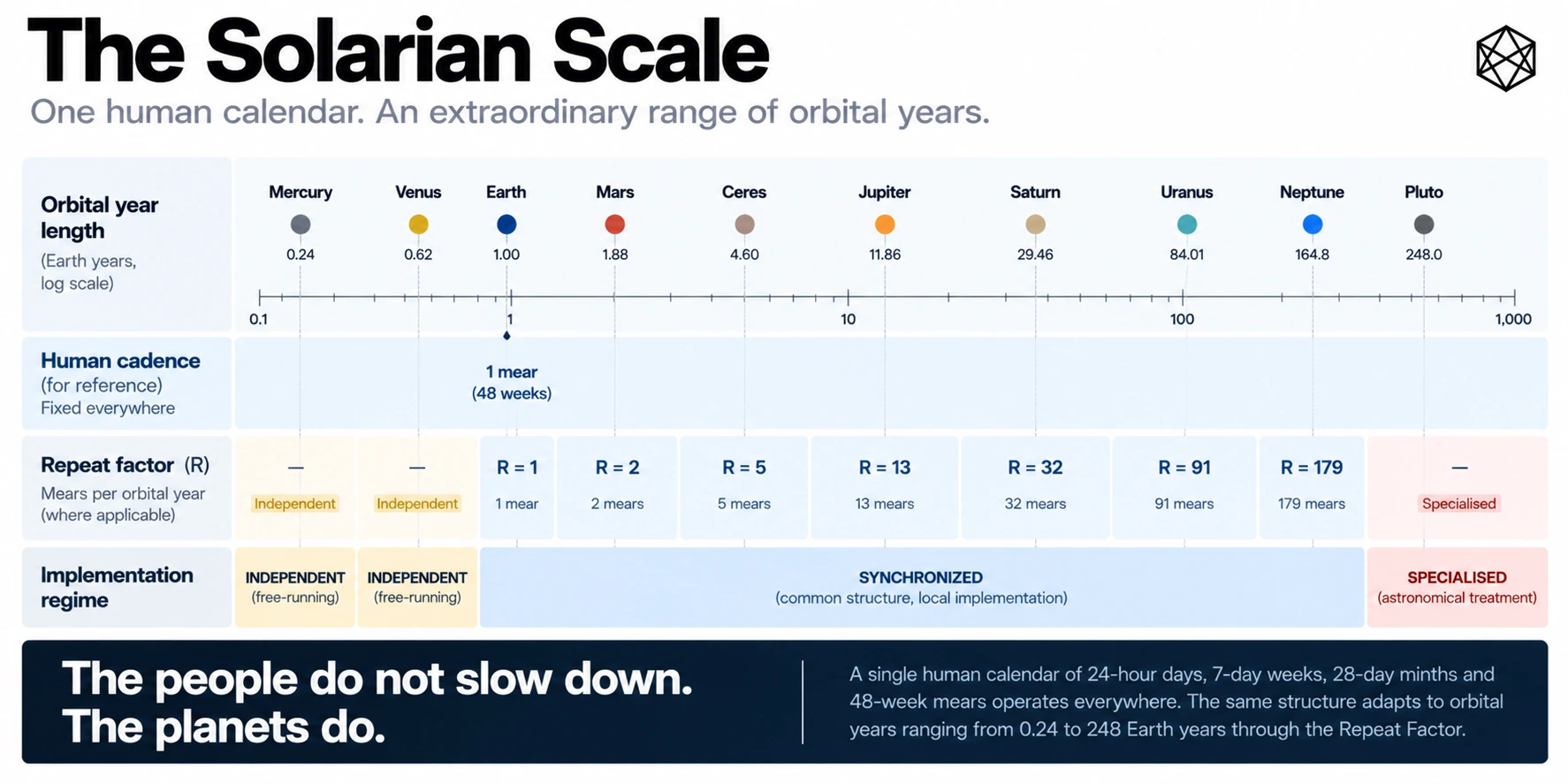
PART V - WHEN THE YEAR GETS SMALLER
Adapting Solarian for The Inner Worlds
So far, most of the Solar System has made the case for separating human operating time from astronomical time by making the astronomical year progressively longer.
The inner Solar System creates the opposite problem.
Here the local year shrinks until it begins to collide with the human operating cycle.
Part V follows that transition through three worlds:
EARTH — the overlap case. The human mear and astronomical year sit so close together that the distinction between them almost disappears.
VENUS — the separation case. The year becomes too short for a useful integer Repeat Factor, so the human and astronomical calendars stop nesting.
MERCURY — the extreme case. Several local years can pass during one human operating cycle, making any attempt to force both clocks into one hierarchy plainly absurd.
Together they reveal the other half of the architecture.
The outer Solar System showed why human time cannot simply expand with the orbit.
The inner Solar System shows why human time should not simply contract with it either.
Solarian therefore has two legitimate modes.
Where the clocks fit together cleanly, synchronize them.
Where they do not, let them run independently.
The architecture should serve the worlds.
The worlds should not be distorted to serve the architecture.