BELONG
25) One Grammar, Many Calendars
What Solarian Actually Gives
Human civilisation began with an enormous piece of hidden infrastructure:
one planet.
For almost all of our history, every society lived beneath the same astronomy. Cultures disagreed about eras, months, holidays and New Year, but nobody had to ask whether a year on one inhabited world should mean the same physical thing as a year somewhere else.
That convenience made calendar design look more universal than it really was.
If humanity becomes a Solar-System civilisation, we lose it.
People may live on worlds whose rotations last hours or months, whose orbital years range from a few terrestrial months to longer than a human lifetime, and whose physical environments bear little resemblance to those that shaped terrestrial civil time. Some communities may inhabit moons, others asteroids, while many may eventually live inside worlds built rather than inherited.
The problem is therefore not really how to invent clever new dates.
It is how one civilisation remains temporally coherent after it no longer shares one astronomical home.
Not one calendar for the Solar System
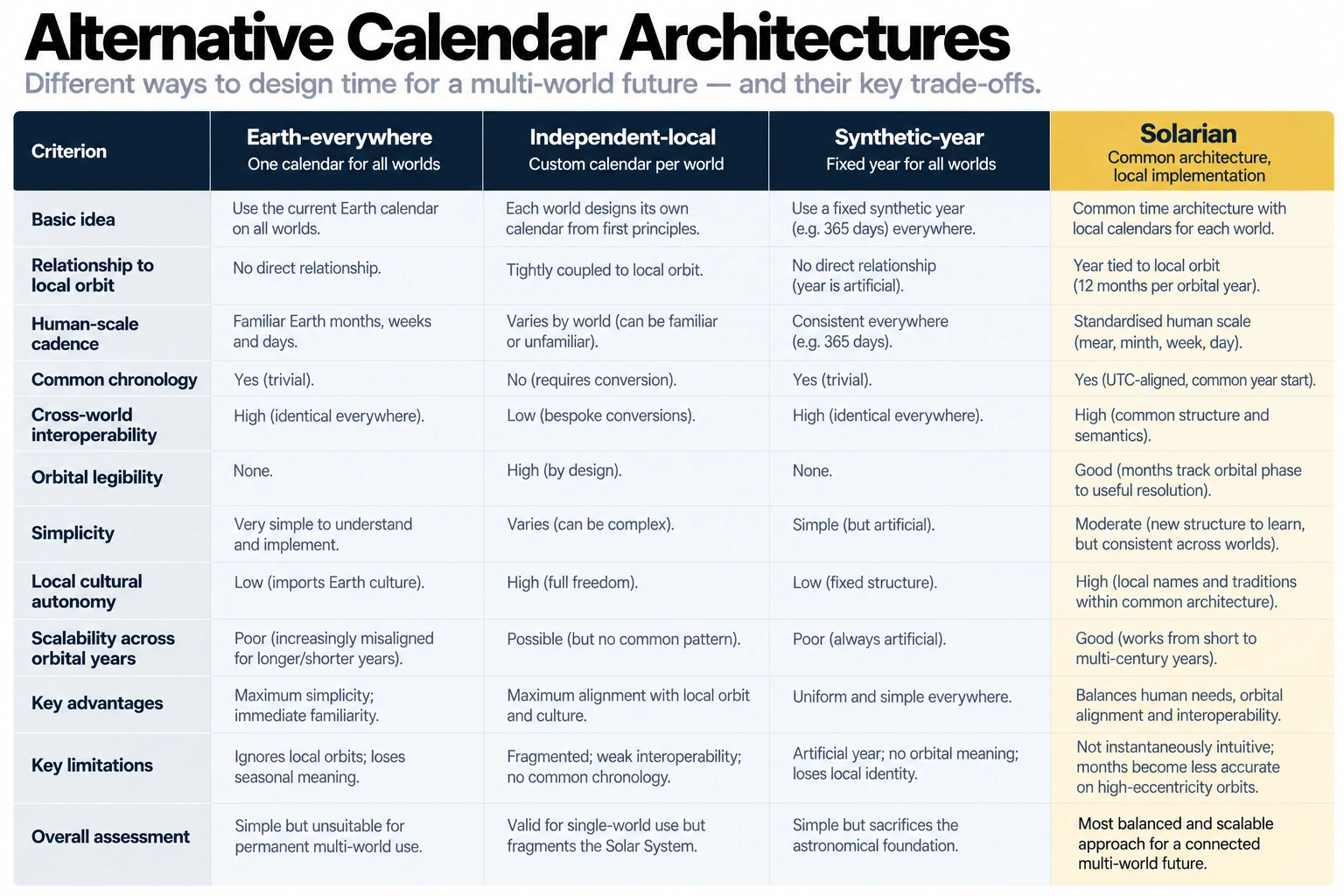
There were always three broad ways to approach that problem.
We could continue using an Earth calendar everywhere. That gives excellent common chronology and minimum initial learning, but very little local astronomical meaning.
We could allow every settlement to invent its calendar independently. That maximises local autonomy, but a civilisation containing hundreds of settlements could eventually inherit hundreds of unrelated assumptions about days, months and years.
Or we can occupy the middle ground:
local calendars with a small shared grammar underneath them
That is the path Solarian has explored.
The phrase Solarian Calendar can therefore be misleading if it suggests one universal calendar page printed identically on Earth, Mars, Ceres, Titan and Neptune.
That is not the idea.
Mars keeps its useful natural sol. Ceres can use the standard human day because its own rotation is unsuitable for ordinary civil life. Saturn keeps its almost thirty-year heliocentric year while the people living around it continue organising their lives through much shorter human cycles.
Venus and Mercury go further: their astronomical years are shorter than the human mear, so the two calendars simply stop nesting and operate independently. Pluto shows that even the standard twelve-month astronomical layer eventually has a boundary.
All of those cases remain recognisably part of one architecture because the functions remain clear even when the implementations differ.
What is actually common
The shared part of Solarian is deliberately small.
Human operating time has a common cadence. Astronomical years retain a common structural meaning where they are useful. Whole weeks provide the preferred civil lattice. Local orbital calendars use a common twelve-position grammar where the orbit supports it. A common chronology and Solarian Week Index provide coordinates for interoperability. Machine identities sit underneath local language.
Those elements are enough to make conversion, records, travel, software and cross-world institutions manageable.
Much else can remain local.
Ceres and Titan do not need the same holidays. Mars and Ganymede do not need the same month names. A future habitat does not need the cultural traditions of Earth merely because it inherited some common temporal machinery from it.
The protocol standardises relationships.
It does not standardise civilisation.
That distinction became one of the most important design principles in the project.
Every extra universal rule may make a standard slightly easier to administer. It also removes one more thing from local control.
The useful question is therefore not:
What can we standardise?
It is:
What genuinely needs to be standardised?
Almost every settlement imagined in this book belongs to people who do not yet exist. It would be an odd act of confidence for somebody on twenty-first-century Earth to decide not only the machine grammar of a future Titanian calendar, but also what Titanians should call their months, which events they should commemorate and how their year should feel culturally significant.
Those things belong to lived history.
A protocol can provide a scaffold.
The society should provide the rest.
The human clock remains human
One of the most useful results of the exercise is how little the human operating calendar ultimately needs to care about astronomy.
The week remains useful on Mars, Ceres, Titan and inside an artificial habitat for essentially the same reason it remains useful on Earth: people and institutions benefit from a recurring short social rhythm. The minth extends that rhythm into a few-week planning unit. The mear extends it again into a larger recurring human cycle without forcing ordinary life to match a planetary orbit.
That separation becomes more valuable as the astronomical scale becomes more extreme.
At Neptune, one year lasts almost 165 Earth years. The orbital year belongs mainly to astronomy and history. Human life continues beneath it in mears.
At Mercury, the relationship reverses. Almost four complete planetary years pass during one mear.
Yet the operating cadence remains useful because it was never supposed to be a disguised planetary year in the first place.
The human clock remains human.
And the year remains astronomical
Solarian makes the opposite decision about the local year.
Where a heliocentric orbit provides a useful civil astronomical cycle, one complete orbit remains one local year. The year is not shortened merely because Saturn takes almost thirty Earth years to complete one or Neptune takes 165.
That gives the year a cleaner job.
It tells a settlement where its world or planetary system sits within its large physical cycle. It does not also have to carry every role that Earth's year historically accumulated: budgets, schooling, age, annual planning, performance cycles, maintenance and ordinary recurrence.
On some worlds, the orbital year remains close to human scale.
On others, it becomes generational.
That is acceptable.
The year belongs to the orbit.
Earth was the coincidence
Looking back from the end of the book, Earth becomes a particularly revealing case.
Our human operating scale and astronomical scale happen to sit unusually close together. One orbit is short enough to organise human life. One-twelfth of that orbit is roughly a familiar few-week interval. The week fits comfortably inside both.
Solarian therefore produces R1, where one mear corresponds to one year and one minth to one orbital month.
The two calendars almost disappear into each other.
That is why separating them feels unnecessary when we look only from Earth. It also helps explain why terrestrial civilisation came to treat month and a few-week operating period as if they were one naturally unified concept.
They are not.
Earth merely made the difference difficult to see.
Once we leave Earth, the coincidence disappears.
The architecture becomes visible.
A system that can say no
The design also became more credible when it encountered cases where the standard form stopped working.
The asteroid belt exposed orbits where equal-time months became increasingly poor approximations of orbital phase. Pluto pushed the problem far enough that the standard synchronized twelve-month layer had to be rejected.
That matters.
A protocol with no failure condition can always appear universal if its definitions are elastic enough.
Solarian instead has boundaries.
The human operating layer can survive where the standard astronomical layer does not. A heliocentric year can remain meaningful even if its usual twelve-month civil representation becomes inadequate. Future settlements can develop specialised astronomical implementations where necessary without pretending those exceptions are the core protocol.
Generality does not mean every environment behaves identically.
It means we know which parts remain general when the environment stops cooperating.
One history, many local dates
The same principle applies across civilisation.
Mars should have Martian dates. Ceres should have Cererian ones. Titan can use the Saturnian astronomical calendar. An independent habitat can use its own heliocentric calendar if one matters, while a mobile habitat can simply use the human operating cadence if it does not.
None of that requires human history to fragment.
A Martian court record can carry a Martian civil date while still being located unambiguously on the common timeline. A Saturnian engineering programme can use local orbital months and human mears while its contracts and archives retain a common chronological coordinate underneath.
One date tells us when something happened there.
Another tells us when it happened for everyone.
That is functional separation, not duplication.
A multi-world civilisation does not need one calendar to possess one history.
A little geography inside the calendar
The common twelve-position orbital grammar also produces a useful side effect.
Where the astronomical layer remains a good approximation of orbital phase, comparing two worlds' month positions gives a rough indication of their geometry around the Sun.
The relationship is crude.
It is not navigation.
It is not an ephemeris.
But in a civilisation containing hundreds or eventually thousands of settlements, that low-resolution mental map could become part of ordinary geographical literacy.
People may learn that Mars is currently moving towards better communication geometry with Earth, or that Ceres and Saturn are broadly on opposite sides of the heliocentric clock, without calculating precise orbital state vectors.
They will have precise numbers whenever they need them.
The useful thing is that they may also possess an intuition before they look.
The calendar quietly becomes part of how people imagine the moving civilisation around them.
That was not the reason Solarian was designed.
It is a useful consequence of giving many worlds one astronomical grammar.
The larger lesson
Calendars are a small subject compared with the challenge of becoming a multi-world species.
Humanity would face far larger questions of law, communications, government, commerce, identity, transport and institutional autonomy long before arguments about the correct month on Neptune became urgent.
Calendars nevertheless expose the structure of the problem unusually well.
Earth allowed physical environment, human routine and common civilisation to coexist inside one inherited set of temporal units. Across the Solar System, those functions separate.
Sometimes the right answer is to preserve the common standard. Sometimes it is to localise. Often it is to do both at different layers.
That is the deeper operating principle behind Solarian.
Common grammar; local culture.
The grammar allows one settlement to recognise the temporal structure of another. It gives machines stable identities. It gives organisations common planning concepts. It gives travellers familiar categories. It gives archives and historians a reliable way to locate events.
The culture sits above it.
Culture names the months. It decides which dates matter. It invents holidays, changes working practices and gradually turns a technical calendar into something people regard as their own.
That distinction is not merely courteous.
It is operationally useful.
Standards become easier to share when they ask fewer people to surrender things that never needed to be standardised in the first place.
Many calendars, one civilisation
A mature Solar System may therefore contain many more civil calendars than Earth does today.
Mars may have a calendar rooted in its sol and orbit. Ceres may develop completely different cultural language above an R5 structure. The great moon systems may share planetary-system calendars. Artificial worlds may adopt independent heliocentric years or use only the human operating cadence when no astronomical year is useful.
Venus and Mercury can allow their astronomical calendars to run independently of the human one. Some eccentric worlds may adopt specialised local astronomical systems.
That diversity is not the problem.
The problem would be allowing every calendar to become an island.
Solarian proposes bridges.
Not one calendar everywhere.
Not hundreds of unrelated calendars everywhere.
One small structural grammar beneath many locally meaningful calendars.
That is what has been built.
The people who get to live there
Somewhere in the future, if humanity is fortunate enough to make the premise of this book real, people may wake beneath skies no human being has yet experienced as home.
They may grow up watching Jupiter dominate the sky above Ganymede. They may live inside a rotating world near Ceres. They may regard Saturn as the ordinary backdrop to childhood rather than something seen through a telescope.
Their calendars will accumulate things no protocol can design.
There will be anniversaries for events that have not happened yet. There will be holidays named after people who have not been born. There will be slang that makes no sense on Earth, old traditions that younger generations roll their eyes at, arguments about whether the calendar was better before some reform, and somebody somewhere will complain that the extra week has ruined the reporting cycle.
Good.
That means the settlement has become a society.
The purpose of Solarian is not to write that society's calendar for it.
It is to leave enough common structure underneath that calendar for the rest of humanity still to understand what it means.
One day, another world may have a calendar that nobody on Earth would have thought to invent.
Solarian is not intended to stop that.
It is simply intended to make sure their calendar can still talk to ours.