PLUTO
17) Where the Protocol Says No
Pluto and Graceful Failure
Pluto is where the standard Solarian calendar finally says no.
Not because its year is too long. Neptune has already shown that a human operating calendar can sit comfortably inside an orbital year longer than a human lifetime. Pluto merely extends that problem: one journey around the Sun takes almost 248 Earth years.
Nor is Pluto difficult because it is small. Ceres, Vesta and the Main Belt asteroids have already shown that Solarian does not particularly care whether the astronomical clock belongs to a planet, dwarf planet or asteroid.
The problem is more fundamental.
Pluto does not move around the Sun evenly enough for the standard Solarian orbital month to keep doing its job.
That makes Pluto useful.
A general architecture becomes more credible when we know where it stops working.
Pluto at a glance
Pluto is a small world of rock and ice in the Kuiper Belt, with a diameter of about 2,376 kilometres and surface gravity around six per cent of Earth's. It has a thin atmosphere dominated by nitrogen, with methane and carbon monoxide, while surface temperatures fall to roughly –230°C and below.
Its orbit is far more eccentric than those of the eight major planets.
| PLUTO SYSTEM | |
|---|---|
| Mean distance from Sun | 5.87 billion km / 39.24 AU |
| Orbital period | 90,560 Earth days |
| Orbital period | 247.94 Earth years |
| Orbital period | 12,937.14 standard weeks |
| Orbital eccentricity | ~0.25 |
| Perihelion | 30.15 AU |
| Aphelion | 48.02 AU |
| Orbital inclination | 17.16° |
| Axial tilt / obliquity | 119.5° |
| Pluto day | 6.387 Earth days |
| Surface gravity | 0.063 Earth gravity |
| Known moons | Charon · Styx · Nix · Kerberos · Hydra |
The warning sign is the distance range. During one orbit Pluto moves from roughly 30 AU to 48 AU from the Sun.
That is not a small variation around an otherwise circular path.
Pluto and Charon
Pluto is also not quite a solitary world.
Charon is roughly half Pluto's diameter, exceptionally large relative to its primary. The two bodies orbit their common centre of mass every 6.387 days and are mutually tidally locked, so the same hemisphere of each always faces the other.
For settlement purposes, the Pluto–Charon pair would naturally form the centre of one local system. Their six-and-a-bit-day physical rotation is not particularly useful as a human civil day, so settlements could simply use the standard Solarian 86,400-second day and seven-day week.
So far, nothing is difficult.
The problem appears only when we try to build the astronomical calendar.
The calendar that almost works
If we ignore Pluto's orbital shape and apply the same arithmetic used elsewhere, the result initially looks excellent.
The physical Plutonian year lasts about:
12,937.14 standard weeks
Divide that by the normal 48-week mear:
12,937.14 ÷ 48 ≈ 269.5
The obvious synchronized candidate is therefore:
R270
That would give:
270 operating mears per orbital year
270 minths per orbital month
3,240 minths per orbital year
The whole-week arithmetic works perfectly well.
Candidate Plutonian implementation
| Solarian element | Candidate implementation |
|---|---|
| Civil day | 86,400 standard seconds |
| Week | 7 standard days |
| Candidate Repeat Factor | R270 |
| Candidate orbital months | 12 — Janplu to Decplu |
| Mears per orbital year | 270 |
| Minths per orbital month | 270 |
| Minths per orbital year | 3,240 |
| Mean physical orbital year | 90,560 days / 12,937.14 weeks |
| Common Year | 12,938 weeks |
| Leap Year | 12,937 weeks |
| Long-run balance | about 1 Common : 6 Leap |
| Nominal unadjusted structure | 12,960 weeks |
| Common Year adjustment | 22 Minth L contractions to 3 weeks |
| Leap Year adjustment | 23 Minth L contractions to 3 weeks |
| Standard Solarian status | FAIL — orbital-month phase fidelity |
Mathematically, Pluto is almost embarrassingly cooperative. Only twenty-two or twenty-three of 3,240 minths need to contract by one week. Common and Leap Years differ by exactly one week. The human structure remains intact throughout.
And yet R270 is not an acceptable standard Solarian implementation.
The arithmetic works.
The astronomy does not.
The problem is orbital eccentricity
The standard Solarian orbital month is supposed to do more than divide elapsed time into twelve convenient pieces. It should also provide a useful coarse indication of where the world is in its orbit.
For relatively modest eccentricities, elapsed time and orbital angle remain close enough for the two structures to coexist. The Main Belt showed where that relationship becomes less secure. A bounded historical screen placed Juno and Bamberga beyond the standard phase threshold, while Eunomia remained in the marginal-review band and could still warrant conservative specialised treatment after individual review. Pluto takes the underlying discrepancy much further.
Pluto goes further.
Its eccentricity is roughly:
e ≈ 0.25
and its distance from the Sun varies from about 30.15 AU at perihelion to 48.02 AU at aphelion.
Because Pluto moves much faster near perihelion than near aphelion, equal intervals of elapsed time no longer correspond to similar amounts of angular progress around the Sun.
That matters.
A calendar can divide time perfectly and still become a poor description of orbital position.
For Pluto, that is exactly what happens.
Equal-time months stop looking like orbital months
A Plutonian year lasts about 248 Earth years. Divide it equally into twelve time-based months and each lasts roughly:
20.7 Earth years
From the human-calendar perspective, this is perfectly manageable. Each month can contain roughly 270 minths and a little over twenty-two mears.
But during those equal twenty-year intervals, Pluto does not move through equal parts of its orbit.
If its orbital motion were uniform, each month would correspond to about:
30° of heliocentric longitude
Instead, the illustrative calculation used in the Solarian screening produces monthly angular movement ranging from roughly:
19° at the slow end
to:
50° at the fast end
The cumulative difference between the nominal twelve-position clock and Pluto's actual orbital longitude can exceed 50 degrees.
That is close to two nominal orbital months.
At that point the problem is no longer rounding.
The calendar still measures elapsed time correctly.
It no longer measures orbital position well enough.
And orbital position is precisely what the astronomical calendar was meant to make legible.
Why not use twelve equal angles?
There is an obvious alternative.
If twelve equal-time months distort the orbit, divide Pluto's path into twelve equal 30-degree angular sectors instead.
Astronomically, that works.
Calendrically, it creates another problem.
Because Pluto moves much faster near perihelion than near aphelion, those twelve equal-angle sectors take very different amounts of time to cross. In the illustrative calculation, individual sectors range from roughly:
12 Earth years
to:
33 Earth years
A “month” near the fast part of the orbit could therefore be less than half the duration of one near the slow part.
That destroys the simple synchronized R270 relationship. A standard R270 orbital month should contain:
270 minths
But 270 normal minths occupy roughly twenty-one Earth years.
We cannot simultaneously require every orbital month to contain 270 minths and every orbital month to represent 30 degrees of Pluto's path. For the more circular worlds, the discrepancy is small enough for whole-week quantisation and intercalation to absorb.
For Pluto, it is not.
That is the point at which the standard synchronized architecture breaks.
The conflict in one table
The problem can be stated compactly:
| Requirement | Equal-time R270 months | Equal-angle months |
|---|---|---|
| 12 orbital months | Yes | Yes |
| 270 minths per month | Yes | No |
| 270 mears per year | Yes | Potentially |
| Whole-week structure | Yes | Possible, but highly irregular |
| Months similar in duration | Yes — ~20.7 Earth years | No — ~12 to 33 Earth years |
| Months approximate orbital position | Poorly | Yes |
| Simple Repeat Factor relationship | Yes | Lost at month level |
| Standard Solarian implementation | No | No |
Pluto forces a choice between two properties that standard Solarian normally provides together:
regular temporal structure
and:
useful orbital-phase structure
At Pluto's eccentricity, the standard protocol cannot preserve both.
So it does not pretend to.
What survives
The important point is that Solarian does not fail completely on Pluto.
The human operating calendar works perfectly well:
86,400-second day
7-day week
4-week normal minth
12-minth mear
Nothing about Pluto's eccentric orbit makes those units less useful. Indeed, with an orbital year lasting almost two and a half centuries, the mear becomes more important rather than less.
The heliocentric year also survives. One complete Pluto–Charon journey around the Sun remains a perfectly meaningful local astronomical year of roughly 248 Earth years.
What fails is much more specific:
The standard twelve-month synchronized astronomical layer does not remain a sufficiently good proxy for Pluto's orbital phase.
That is a narrower and more useful conclusion than saying “Solarian does not work on Pluto”.
The human calendar works.
The year works.
The standard bridge between them does not.
Pluto and Charon still share one year
The Pluto–Charon binary does not create an additional difficulty.
Pluto and Charon orbit their common barycentre every 6.387 days, while the entire system travels around the Sun together. Any future settlements on Pluto, Charon or nearby habitats would therefore naturally share the same heliocentric year.
Charon's local orbit remains useful operational information, just as Ganymede's does at Jupiter or Titan's at Saturn.
But changing the local reference body cannot fix the calendrical problem.
Pluto and Charon share the same eccentric heliocentric journey.
The issue belongs to the system's orbit around the Sun.
A year longer than civilisations
Pluto also pushes the distinction between human and astronomical time further than any world considered so far.
A person will not merely fail to see two Plutonian New Years. Several generations can pass during one.
A settlement founded early in a Plutonian year could be centuries old before that year ended. Even one hypothetical equal-time orbital month lasts more than twenty Earth years.
The mear would therefore carry almost everything humans currently associate with annual life: age, education, budgeting, anniversaries, maintenance, contracts, institutional planning and recurring civic rhythms.
The Plutonian year becomes something else.
It is astronomical and historical.
A civilisation could use it to locate itself within Pluto's long journey around the Sun, while individual human lives unfold almost entirely within a small fraction of that journey.
Pluto therefore makes the case for the human operating calendar exceptionally strongly.
It just happens to break the standard orbital month at the same time.
Graceful failure
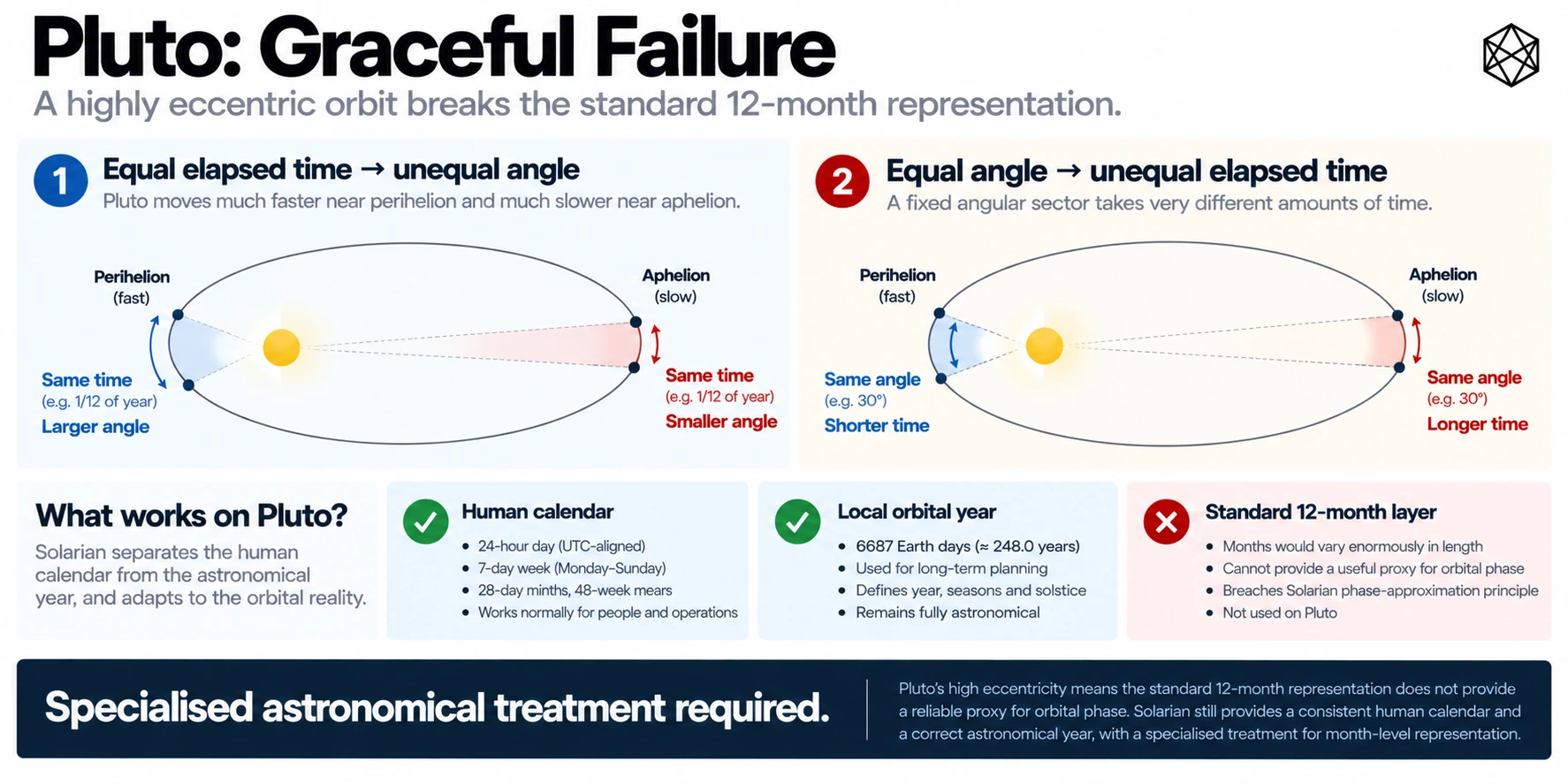
There are two ways a general protocol can respond to an awkward case.
One is to keep adding exceptions until it can continue claiming universal success.
That usually produces a worse protocol.
The other is to define what the architecture is trying to achieve, test the difficult case against those requirements and admit when one of them is no longer satisfied.
Solarian should take the second approach.
Pluto shows that there is a practical limit to the standard synchronized astronomical layer. Below that limit, twelve orbital months remain a useful civil proxy for heliocentric progress while the Repeat Factor keeps those months connected to the human operating calendar.
At sufficiently high orbital eccentricity, those two properties pull apart.
The asteroid belt showed the beginning of the problem.
Pluto makes it impossible to ignore.
So the standard Plutonian result is:
Human operating calendar: YES
Heliocentric orbital year: YES
Standard synchronized twelve-month layer: NO
R270 arithmetic: valid, but not adopted as a standard Solarian implementation
That distinction belongs in the protocol.
It is not an embarrassment to it.
A general architecture should be able to describe its boundary without collapsing beyond it.
What would Plutonians actually do?
That is ultimately a local design problem.
A future Pluto–Charon civilisation could keep the standard human week → minth → mear calendar and use precise orbital longitude or ephemeris data whenever heliocentric position matters.
It could construct a special Plutonian astronomical calendar using unequal-duration orbital sectors. Or it could develop some other local representation better suited to an eccentric Kuiper Belt orbit.
Solarian does not need to decide that for them.
The important thing is to label the result honestly.
A special Plutonian astronomical calendar would be a local extension or exception, not evidence that the standard protocol had somehow worked unchanged after all.
Future Plutonians can solve the cultural details themselves.
They have roughly 248 Earth years between New Years to argue about it.
Where Part IV leaves us
The three cases in this part have now tested Solarian in quite different ways.
The Main Belt showed that a common grammar can generalise across a population of independent natural worlds, while also exposing the first eccentricity-driven exceptions. The free-space habitat showed the opposite case: when humans build the world themselves, the astronomical environment can become part of the design space.
Pluto gives us the boundary case.
Its human operating calendar remains useful. Its local year remains real. But the standard synchronized twelve-month astronomical layer no longer earns its place.
That is a useful result.
A protocol does not demonstrate generality by refusing to fail.
It demonstrates generality by failing in a precise, intelligible way.
Pluto does exactly that.