FLEX
8) The Week Does Not Break
Expansion Joints, Leap Weeks & Mondays
The Repeat Factor gives a synchronized Solarian calendar its clean underlying structure.
Real astronomy then spoils the arithmetic.
An R5 world nominally contains five 48-week mears, an R13 world thirteen, and so on. But physical orbital years do not arrive in exact multiples of four-week minths or seven-day weeks, so the civil calendar needs a controlled way to absorb the difference without destabilising the structures people use most often.
That is the purpose of the expansion joint.
A normal minth contains four complete weeks. At designated positions, a minth may instead contain three or five weeks, allowing the civil calendar to remain close to the physical orbit while preserving complete weeks throughout.
Most of the structure therefore stays rigid.
The unavoidable movement is absorbed where we deliberately put it.
The primary expansion joint
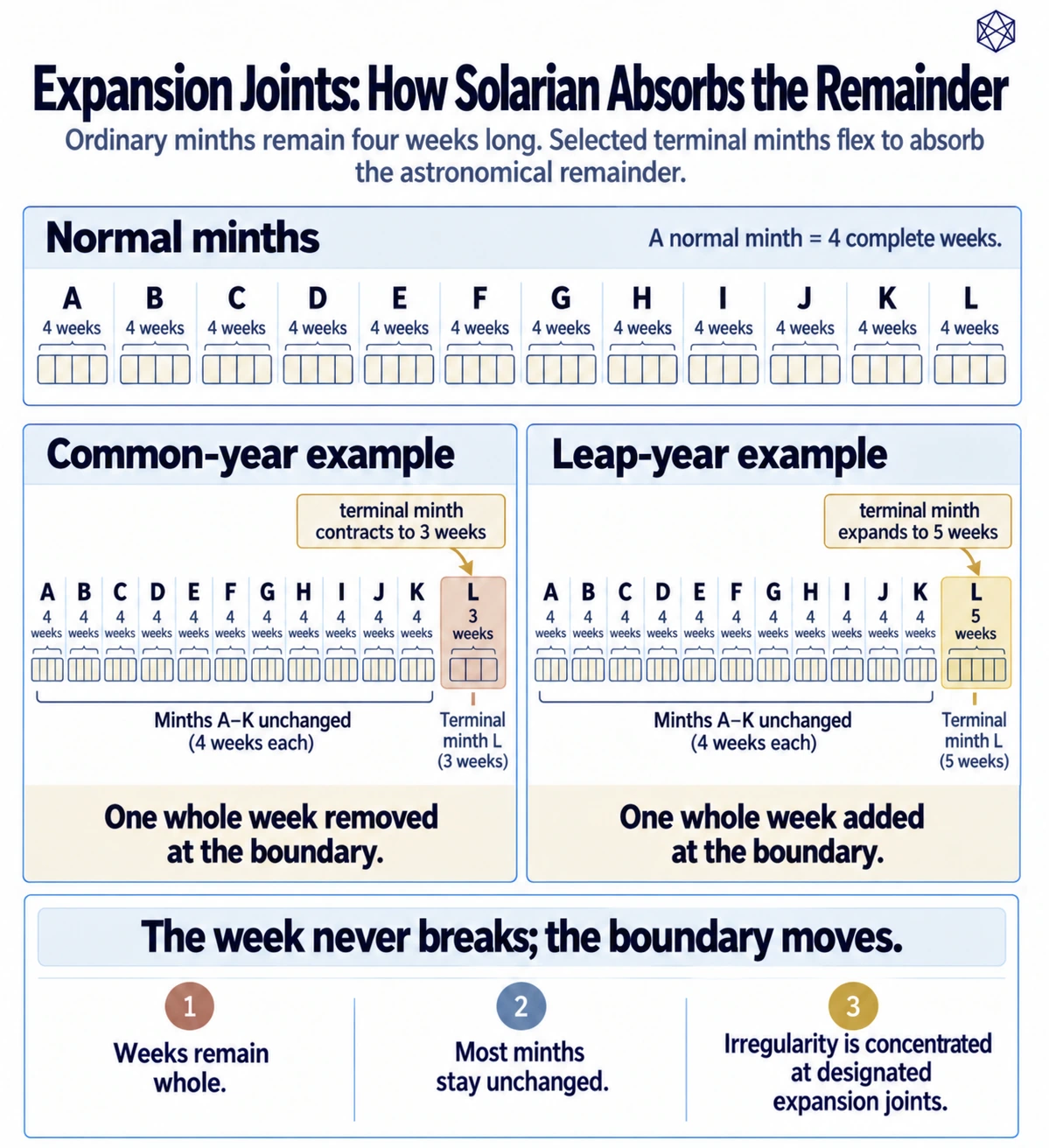
The normal Solarian expansion joint is Minth L, the final minth of every mear.
In its ordinary form, L contains four weeks like every other minth. Where adjustment is required, selected L minths can contract to three weeks or expand to five:
… J = 4 weeks · K = 4 weeks · L = 5 weeks
or:
… J = 4 weeks · K = 4 weeks · L = 3 weeks
The next mear then begins cleanly with Minth A.
Putting the normal flexibility at the end of the mear keeps irregularity at a known structural boundary rather than scattering it unpredictably through the operating calendar. A long orbital year containing many mears also provides several separate points at which small corrections can be distributed.
The objective is not for every mear to have exactly the same duration.
It is for everybody to know where variation is allowed.
Secondary expansion joints
For all planets, and almost all asteroids, the mear-terminal Minth L provides enough adjustment capacity. Some astronomical cases require more.
Where the required correction cannot be accommodated entirely through the primary L positions, Solarian allows additional designated minths to act as secondary expansion joints. These are selected systematically and distributed as evenly as practical rather than introduced opportunistically whenever the arithmetic becomes awkward.
Nothing fundamental changes.
A secondary expansion joint is still an ordinary A–L minth whose realised duration can move from four weeks to three or five. It introduces no new calendar unit, does not alter the recurring minth sequence and never breaks the week.
It simply creates another controlled place where the calendar can flex.
Most implementations will not need secondary joints. Some of the more awkward asteroid cases later in the book will. The important point is that the mechanism exists in the protocol before we encounter them.
Whole weeks are the smallest adjustment
Solarian treats the complete week as its smallest structural building block.
The technical term is quantisation, although the idea is much simpler than the word. Minths contain whole weeks, mears contain whole minths, and orbital-month and civil-year boundaries also fall on week boundaries.
When astronomical correction is required, the smallest adjustment is therefore:
One complete week.
Solarian does not repair a mismatch by inserting an isolated Tuesday, removing a Friday or creating a special day outside the weekday sequence.
The physical orbit is continuous.
The civil calendar is discrete.
This is the practical expression of the design principle established earlier:
Distribute irregularity; preserve structure.
The astronomical remainder must be absorbed somewhere.
Solarian chooses not to make the week pay for it.
Intercalation in weeks
The second technical term is intercalation: the periodic correction used to keep a civil calendar aligned with its underlying astronomy.
Gregorian uses leap days.
Solarian uses whole-week adjustments.
A designated expansion joint can therefore gain or lose a week relative to its normal four-week form. Across the appropriate long-run sequence, those changes keep the discrete civil calendar close to the continuous physical orbit without disturbing the seven-day rhythm underneath.
The precise pattern differs from world to world because the astronomy differs. The mechanism remains the same.
On a long-period world, a single week is tiny relative to the complete orbit. Even on shorter synchronized worlds, distributing correction through known expansion joints keeps the irregularity bounded, visible and predictable.
Common Years and Leap Years
Solarian also needs consistent language for the alternate whole-week forms of a local civil orbital year.
The convention is:
A Common Year contains an even number of weeks.
A Leap Year contains an odd number of weeks.
This definition is deliberately structural.
A Solarian Leap Year is not necessarily longer than its Common Year.
Gregorian conditions us to think of a leap year as the form that gains time, but across many different orbital periods the best adjacent whole-week approximations can fall on either side of the physical year.
Mars provides the first useful example. Its Common Year contains 96 weeks, while its Leap Year contains 95.
The Leap Year is therefore the shorter form.
That is not a contradiction. In Solarian, Leap simply identifies the odd-week alternate year; it does not mean “longer” or “rarer”.
This gives every implementation one consistent vocabulary even when the underlying intercalation patterns differ substantially.
The Monday Rule
Whole-week construction has one further consequence.
Every major Solarian civil calendar boundary always begins at the start of a week.
Using familiar terrestrial weekday names:
Every orbital year begins on a Monday.
Every orbital month begins on a Monday.
Every operational mear begins on a Monday.
Every operational minth begins on a Monday.
Everywhere.
Because all of those units contain complete weeks, each also ends on a Sunday.
“Monday” and “Sunday” are reference names rather than compulsory cultural vocabulary. Future societies may call their weekdays something entirely different; the protocol only cares that each major boundary occupies the same first-weekday position.
This removes a surprising amount of ordinary calendar friction. A new minth never begins halfway through a working week, an orbital month does not suddenly start on Thursday, and New Year does not migrate through the weekday cycle from one occurrence to the next.
Durations can flex where astronomy requires it.
Boundaries do not drift through the week.
The mechanism in one view
The practical machinery can now be summarised very compactly.
Whole-week quantisation means the civil calendar is built and adjusted in complete weeks.
Controlled intercalation places normal adjustment in mear-terminal Minth L, with designated secondary expansion joints available where greater correction is required.
The Monday Rule keeps every major calendar boundary on the first weekday.
And the year forms follow one common convention:
even number of weeks = Common Year
odd number of weeks = Leap Year
None of these rules removes astronomical irregularity.
They decide where it is allowed to appear.
The result is a calendar in which higher-level durations can flex while the structures people encounter most frequently remain stable. Weeks stay whole, minth positions remain recognisable, mears always contain twelve minths, and orbital years remain tied to real astronomy.
The irregularity is not hidden.
It is bounded and deliberately placed.
One useful consequence
There is one final benefit to constructing the standard-day Solarian calendars entirely from uninterrupted whole weeks.
The weekday sequence never needs to restart. Monday continues to Tuesday and eventually back to Monday across minth boundaries, mear boundaries, orbital months, New Year and every expansion week. For settlements using the standard 86,400-second civil day, those uninterrupted week sequences can therefore share the same physical phase across different worlds.
Mars is the important qualification because its seven-day week is built from slightly longer sols and must therefore be mapped to the standard-day sequence. Most other Solarian settlements can share it directly.
That means worlds can possess different orbital years, different month lengths and different Repeat Factors while still sitting on one continuous weekly grid.
And once that common grid exists, there is an obvious next step.
We can count the weeks.