FREE SPACE
16) When We Get to Choose the Orbit
Free Space Habitats - Cylinders, Spheres & Rings
Every world considered so far has arrived with its astronomy already attached.
Mars has the orbit Mars has. Ceres cannot ask for a slightly shorter year, while Bamberga cannot circularise itself because future calendar designers find an eccentricity of 0.34 inconvenient.
Artificial worlds are different.
A sufficiently advanced civilisation may build large permanent settlements directly in space rather than adapting every community to the surface of a planet, moon or asteroid. Those habitats could take many forms — cylinders, spheres, rotating rings and eventually structures much larger than anything humans have yet constructed — but they share one important characteristic.
Their environment is engineered.
And, to some extent, so is their orbit.
That changes the design question. We are no longer merely asking:
What calendar does this world inherit?
The more interesting question is:
If we build the world ourselves, which parts of the calendar are still inherited from nature?
The answer turns out to be: fewer than before.
Building a world rather than settling one
The best-known example is the O'Neill cylinder.
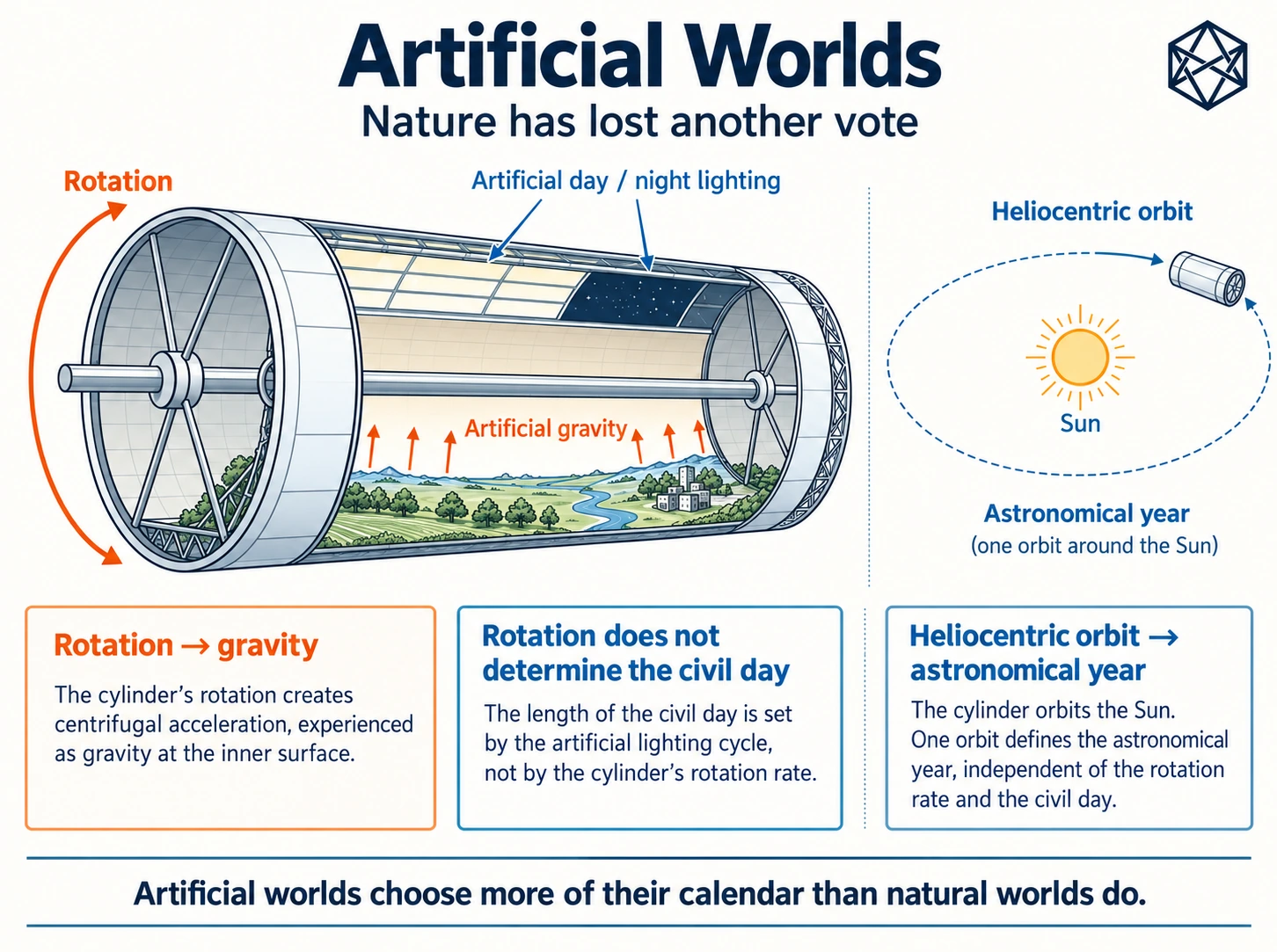
Imagine an enormous hollow cylinder rotating around its long axis. People live on the inside surface, with rotation producing an apparent outward acceleration that plays the role gravity normally performs on a planetary surface.
For someone standing inside, the curved hull beneath their feet behaves as the ground. “Down” points away from the central axis towards the structure, while moving towards the axis reduces the apparent gravity until the central region approaches microgravity.
A sufficiently large cylinder can rotate slowly enough to produce comfortable artificial gravity without the unpleasant effects associated with a small, rapidly spinning habitat. For our illustrative example, imagine a structure about eight kilometres in diameter and thirty kilometres long. At a radius of roughly four kilometres, a rotation rate of around half a revolution per minute would provide approximately Earth-normal gravity at the inhabited surface.
That means the habitat completes a mechanical rotation roughly every two minutes.
This is excellent for gravity.
It is a spectacularly bad definition of breakfast.
The rotation therefore has no reason to become the civil day. Internal lighting, mirrors, shutters or other environmental systems can provide whatever day-night cycle the inhabitants choose. Solarian simply uses the standard 86,400-second civil day and seven-day week already shared by other standard-day settlements.
The distinction is worth stating plainly:
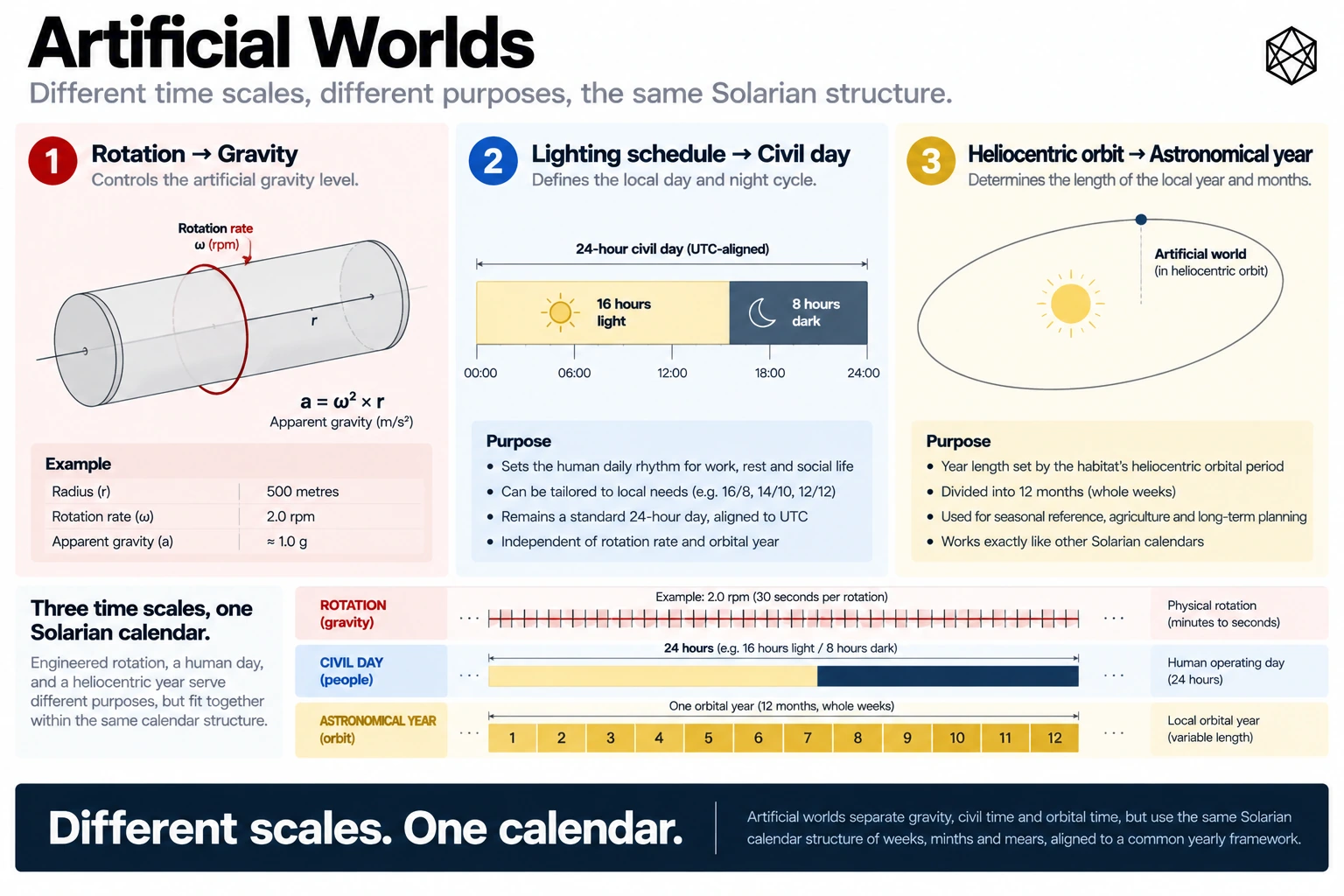
Rotation creates gravity. It does not have to create time.
Mars can use its rotation as a civil day because the Martian sol happens to sit conveniently close to human biological time. An artificial world has no reason to pretend that the engineering rotation of its structure is an astronomical commandment.
The first inherited relationship has disappeared.
The habitat's rotation no longer dictates its day.
Cylinders are only one geometry
The cylinder is useful because it makes the idea easy to picture, but there is nothing calendrically privileged about it.
A Bernal sphere places people inside a rotating spherical habitat. A Stanford torus places the inhabited surface around a rotating ring, while larger future ring structures could extend the same principle to populations comparable with major terrestrial cities or eventually nations.
Those geometries matter enormously for engineering. They affect structural loads, artificial gravity, transport, landscape design, radiation protection and the psychological experience of living inside the world.
They do not define the astronomical year.
For Solarian, the relevant external fact is the habitat's orbit around the Sun. A cylinder, sphere and torus occupying the same heliocentric orbit would share the same astronomical calendar even if almost everything about life inside them felt different.
Their shape belongs to the engineered world.
Their year belongs to the orbit.
So a second distinction appears. The physical architecture of an artificial world can determine gravity, landscape and internal environment without determining its civil year.
That still comes from somewhere outside the hull.
Where artificial worlds belong
Not every free-space habitat would need its own heliocentric calendar.
Many would probably be constructed where the surrounding geography already provides an obvious civil home: near planets and moons, around resource-rich asteroids, along transport corridors or within stable gravitational environments associated with existing settlement systems.
A large habitat permanently embedded in the Jovian system would normally use the Jovian astronomical year. A cylinder closely associated with Earth could use Earth's. A settlement operating as part of the Martian system might inherit the Martian astronomical calendar even if its internal civil day remained the standard 86,400 seconds rather than a sol.
Solarian does not award every sufficiently impressive piece of engineering its own year.
The independent case becomes interesting when a habitat occupies a persistent independent heliocentric orbit and develops enough permanence and civic identity for that orbit to matter.
Such settlements need not be distributed randomly. Their locations would be chosen primarily for engineering and economic reasons: transport energy, resource access, radiation, thermal conditions, solar power, stationkeeping, collision risk and the evolving geography of human activity.
Nobody sensible is going to move a city several million kilometres because somebody in the standards department prefers the resulting calendar.
But artificial worlds begin with something natural worlds do not have.
A choice.
And where several technically reasonable choices exist, the calendrical consequences can legitimately enter the discussion.
A cylinder between Mars and the Main Belt
Consider a large O'Neill cylinder in an independent, nearly circular heliocentric orbit beyond Mars but comfortably inside the principal Main Belt.
It does not orbit Mars. It is not attached to an asteroid. It travels independently around the Sun and therefore has a genuine heliocentric year of its own.
For this worked example, choose a semimajor axis of approximately:
1.970 AU
That produces an orbital period close to:
1,009.75 standard days
or:
144.25 standard weeks
or:
2.76 Earth years
The orbit is deliberately close to circular.
That would be attractive for several reasons independent of calendaring, but it also means the twelve-part Solarian astronomical clock remains a good coarse representation of heliocentric position. The artificial world avoids the orbital-phase problems encountered among the more eccentric asteroids.
The chosen orbital period also produces something not yet represented among our major worked examples:
R3
Mars gave us R2. Vesta begins the Main Belt at R4.
The artificial habitat fits neatly between them.
That is not why a civilisation would build it there.
It is nevertheless a useful consequence — and our first example of a world whose astronomical environment was not simply handed to its inhabitants by nature.
The canonical R3 habitat
The physical dimensions below are illustrative rather than part of the Solarian protocol, and the orbit is equally hypothetical. A real settlement would require detailed engineering, dynamical and economic analysis rather than a calendar designer displaying suspicious enthusiasm for multiples of forty-eight.
| HYPOTHETICAL R3 FREE-SPACE HABITAT | |
|---|---|
| Settlement type | Independent rotating habitat |
| Heliocentric location | Beyond Mars, inside principal Main Belt |
| Mean distance from Sun | ~1.970 AU / ~295 million km |
| Orbital period | ~1,009.75 standard days |
| Orbital period | ~144.25 standard weeks |
| Orbital period | ~2.76 Earth years |
| Orbital eccentricity | Very low by design; illustrative target ~0.01 |
| Solar energy at orbit | ~26% of Earth-orbit solar flux |
| Illustrative cylinder diameter | ~8 km |
| Illustrative cylinder length | ~30 km |
| Artificial surface gravity | ~1.0 g |
| Illustrative rotation rate | ~0.5 rpm |
| Natural civil day | None |
| Civil day | 86,400 standard seconds |
| Day/night environment | Engineered internally |
The important number for the calendar is the orbital period.
A year of 144.25 weeks sits almost exactly on three ordinary 48-week operating mears:
3 × 48 = 144 weeks
That gives the habitat one of the cleanest synchronized calendars in the book.
The R3 Solarian calendar
| Solarian element | R3 habitat implementation |
|---|---|
| Civil day | 86,400 standard seconds |
| Week | 7 standard days |
| Repeat Factor | R3 |
| Orbital months | 12 — local names chosen by residents |
| Mears per orbital year | 3 |
| Minths per orbital month | 3 |
| Minths per orbital year | 36 |
| Mean physical orbital year | ~1,009.75 days / 144.25 weeks |
| Common Year | 144 weeks |
| Leap Year | 145 weeks |
| Long-run balance | 3 Common : 1 Leap |
| Nominal unadjusted structure | 144 weeks |
| Common Year adjustment | None |
| Leap Year adjustment | Final Minth L expanded to 5 weeks |
| Common orbital months | 12 × 12 weeks |
| Leap orbital months | 11 × 12 weeks + final month at 13 weeks |
| Year structure | Mear 1: Months 1–4 · Mear 2: Months 5–8 · Mear 3: Months 9–12 |
In one line:
The habitat is R3 — three minths per orbital month and three operating mears per heliocentric year.
The arithmetic is almost embarrassingly polite. The physical year is 144.25 weeks, while three normal mears provide 144 weeks:
144.25 ÷ 48 ≈ 3.005
The synchronized implementation is therefore unambiguously R3.
Thirty-six minths complete the year whether we read it through the human or astronomical structure:
3 mears × 12 minths = 36 minths
and:
12 orbital months × 3 minths = 36 minths
The two calendars meet unusually cleanly.
A completely ordinary Common Year
The habitat's Common Year requires no intercalation at all.
Every one of its thirty-six minths contains four weeks. Each mear therefore contains the normal 48, giving:
48 + 48 + 48 = 144 weeks
Each orbital month contains three normal minths, or twelve weeks, and twelve identical orbital months give:
12 × 12 = 144 weeks
No expansion joint changes anywhere in the Common Year. The human structure and astronomical structure are both regular from beginning to end.
The physical orbit is not exactly 144 weeks, of course. Our illustrative target is 144.25, so over time the civil calendar needs an average additional quarter-week per orbital year.
Three 144-week Common Years followed by one 145-week Leap Year produce:
144 + 144 + 144 + 145 = 577 weeks
across four orbital years, giving:
577 ÷ 4 = 144.25 weeks
The Leap Year alters only the final primary expansion joint. Minth L of the third mear grows from four weeks to five, making the final orbital month thirteen weeks rather than twelve.
Everything before it remains unchanged.
The memorable implementation is therefore:
Common Year = 144 weeks
Leap Year = 145 weeks
3 Common : 1 Leap
A real settlement would define its deterministic long-run intercalation from its actual maintained orbit, but the canonical example shows how little machinery is required.
R3 has an unusually transparent internal structure
There is a second piece of elegance in R3.
Each orbital month contains three minths. Each mear contains twelve. So every mear contains exactly four complete orbital months:
4 orbital months = 1 mear
and:
3 mears = 1 orbital year
The calendar therefore falls naturally into three large operating blocks:
Mear 1 — Months 1–4
Mear 2 — Months 5–8
Mear 3 — Months 9–12
Within the first mear, the minths divide equally across those months:
Month 1 — A · B · C
Month 2 — D · E · F
Month 3 — G · H · I
Month 4 — J · K · L
The next mear begins again with A, and the same structure repeats through Months 5–8 and 9–12.
Residents would not need to calculate any of this.
That is rather the point.
The relationship is visible enough that ordinary calendars, planning systems and software could present it without asking users to understand the mathematics underneath. Every four orbital months, the astronomical and human structures meet at a mear boundary; every twelve months, all three mears and the heliocentric year complete together.
It is one of the clearest demonstrations in the book of what the Repeat Factor is actually doing.
But the more important point for this chapter is why such a neat relationship is even available.
The habitat's astronomy was not wholly inherited.
Part of it was chosen.
The rotation is not the day
The artificial habitat also provides the purest example yet of why Solarian distinguishes a physical rotation from a civil day.
Our cylinder rotates about once every two minutes. That mechanical cycle creates gravity.
Nobody counts it as a morning.
Internal lighting can instead follow the standard 24-hour civil clock, producing a human-scale sequence of waking, work, recreation and sleep. The habitat can synchronise that cycle to the wider standard-day Solar System even though nothing outside the window rises or sets every twenty-four hours.
This is not an artificial workaround for a deficient world.
Artificiality is the world.
A habitat exists precisely because engineering has taken over environmental functions that natural planets perform accidentally. Gravity can be engineered. Light can be engineered. Temperature can be engineered.
The civil day can therefore be chosen for its usefulness to human beings rather than inherited from the spin rate of the structure producing their gravity.
Nature has lost another vote.
Nor are there natural seasons
The same distinction applies to seasons.
A planet with axial tilt and an atmosphere may experience a strong physical seasonal cycle. A rotating habitat has no requirement to reproduce one internally.
Its designers could keep temperature, daylight, rainfall and agricultural conditions nearly constant throughout the heliocentric year. They could equally choose to create seasons because residents prefer them, ecosystems benefit from them or local culture eventually expects them.
Those would be real lived seasons.
They would simply be engineered ones.
They would not define the orbital calendar.
Outside the hull, meanwhile, the habitat continues to move around the Sun. Its changing heliocentric position remains physically meaningful even if somebody sitting beneath a tree in an internal park cannot infer the orbital month from the weather.
This gives the artificial world perhaps the cleanest possible separation between Solarian's two calendars.
The human calendar describes life inside the world.
The astronomical calendar describes where the world is outside it.
Why keep an orbital calendar at all?
That separation raises an obvious challenge.
If the habitat controls its gravity, daylight, weather and perhaps much of its agriculture, why bother with a heliocentric year?
Because the artificial world is still part of the Solar System.
Its orbital position affects transport geometry, communication distance, solar orientation and its relationship with Earth, Mars, the Main Belt and every other moving settlement.
A permanently independent habitat at around 1.97 AU also acquires an astronomical identity of its own. Its citizens may inhabit an engineered landscape, but their entire world is still travelling around the Sun.
The orbital calendar gives that journey a civil expression.
This is the important limit to the idea that artificial worlds can simply choose arbitrary time. They can engineer much of their immediate environment, but their external geography remains real.
Solarian gives them both.
Human-scale cadence need not imitate the orbit.
The astronomical calendar need not imitate the internal environment.
Choosing the boring orbit
The contrast with the asteroid chapter is especially useful.
Bamberga did not choose its eccentric orbit after reviewing future civil-calendar requirements. Juno was not asked whether a more circular path would make life easier.
An artificial settlement can be less dramatic.
If engineering, transport and resource considerations permit a low-eccentricity orbit, there may be no advantage in choosing a highly eccentric alternative. A near-circular orbit offers relatively stable solar conditions and, as a side effect, makes the twelve-position Solarian astronomical calendar a clean representation of heliocentric progress.
That does not mean calendar convenience should determine orbital design. It means good engineering choices in one domain can produce useful consequences in another.
A boring orbit can be a feature.
Designing the world around the calendar — at the margin
There is a more interesting possibility.
Suppose planners identify several nearby heliocentric orbits that perform similarly across the variables that actually matter: transportation, resources, solar energy, long-term stability, thermal conditions and integration with the wider settlement network. No candidate is decisively better. Their orbital periods differ modestly.
At that point, civil architecture can legitimately become one of the secondary design criteria.
An orbit close to 144.25 weeks gives the settlement an exceptionally clean R3 calendar. A slightly different orbit might still produce R3 but require more frequent adjustment. Move far enough and the settlement eventually approaches another Repeat Factor altogether.
Again, nobody should burn heroic quantities of propellant merely to save the calendar committee a page of intercalation rules.
But civilisation already makes physical design choices partly for human usability. Buildings are oriented for light. Cities are organised around transport. Infrastructure standards affect engineering decisions.
A deliberately created world could reasonably include the quality of its long-run civil calendar among those considerations when the more important constraints leave room to choose.
That is something no natural settlement can do.
We would not merely design the calendar around the world.
We could, at the margin, design the world around the calendar.
That is the central turn of the chapter.
For the first time, the relationship runs both ways.
The Solarian Week comes for free
The habitat also fits directly into the Solarian Week architecture.
Its civil day contains the standard 86,400 seconds and its week seven standard days, so it occupies the same weekday phase as Ceres, Jupiter, Saturn and other standard-day Solarian settlements.
Its astronomical year is local.
Its underlying week is shared.
That would be especially useful for an artificial settlement positioned as a transport, industrial or commercial node between Mars and the Main Belt. A freight organisation could operate across several local orbital calendars while planning common activity against the same Solarian Week Index.
The astronomical coordinates differ.
The operational grid does not.
Nothing new needs to be invented for the habitat to participate.
Not every habitat gets a year
Artificiality alone is not enough to justify an independent astronomical calendar.
A cylinder associated permanently with the Earth–Moon system can simply use Earth's heliocentric year. A habitat inside the Jovian system normally belongs to the Jovian astronomical calendar. A large Martian orbital settlement might reasonably share the Martian year even if its residents use standard-duration civil days internally.
The independent R3 example earns its local year because the settlement itself occupies a persistent independent heliocentric orbit.
Solarian follows meaningful astronomical geography.
It does not create calendars for the pleasure of creating calendars.
This distinction becomes still clearer for a moving settlement.
A transport ship travelling from Earth to Mars does not acquire a new civil year every time its trajectory changes. Nor does a mobile habitat on an evolving orbit necessarily possess a persistent astronomical cycle worth turning into a local calendar.
Its human operating structure can continue perfectly well:
day → week → minth → mear
The astronomical layer is useful when there is a stable astronomical home to represent. Where there is not, it can simply be absent.
That is a feature of the two-calendar architecture, not a failure of it.
And it gives the chapter's opening question one more answer.
An artificial settlement can engineer its gravity, day, seasons and perhaps even choose among plausible orbital homes.
But it does not need to invent astronomical identity where no stable astronomical home exists.
The first deliberately designed world
The importance of the R3 cylinder therefore goes beyond filling a numerical gap between Mars and Vesta.
Mars, the giant-planet systems and the asteroids all pose versions of the same problem:
How should humans organise time inside astronomy they inherit?
The artificial habitat asks the question the other way around:
If we build the world ourselves, which parts of the calendar are still inherited from nature?
Our canonical example gives a fairly clear answer.
Its gravity is engineered, so rotation does not define the civil day. Its illumination and seasons can be engineered, so neither needs to define civil time. Its standard human day and week can be selected for interoperability. Its orbit can be chosen from within the constraints imposed by physics, engineering and economics. If that orbit becomes a persistent astronomical home, it can then define a genuine local year.
In this example, that gives:
3 minths per orbital month
4 orbital months per mear
3 mears per orbital year
36 minths per orbital year
144-week Common Year
145-week Leap Year
The Common Year needs no correction at all. The Leap Year needs one additional week.
That is R3.
More importantly, nothing about the result depends on the settlement being cylindrical. A sphere or ring in the same orbit could use exactly the same calendar.
The physical architecture defines the engineered environment. The human calendar defines recurring life inside it. The heliocentric orbit defines the astronomical year.
Those three things can be designed together without being confused with one another.
Nature versus design
That is why this chapter belongs between the asteroids and Pluto.
The asteroid belt tested Solarian against a population of natural worlds and revealed both elegant calendar families and inconvenient exceptions.
The artificial habitat demonstrates the opposite case.
Its designers can choose a nearly circular orbit. They can choose an Earth-scale civil day. They can choose approximately Earth-normal gravity. And, where wider engineering constraints permit, they can choose an orbital scale that produces an unusually clean relationship between human and astronomical time.
Pluto gets no such choice.
Its orbit is whatever nature gave it.
That is the fundamental distinction.
Natural worlds inherit their astronomy. Artificial worlds can, at least partly, engineer it.
And that means the calendar is no longer only a response to the world.
For the first time, it can become one small part of designing the world itself.