ASTEROIDS
15) A Population, Not a World
The Main-Belt Generalisation Test
The asteroid belt is not a world.
It is a population.
Between Mars and Jupiter lie millions of small bodies left over from the formation of the Solar System. They range from Ceres, almost 1,000 kilometres across and massive enough to be classified as a dwarf planet, through hundreds of substantial asteroids and eventually down to rocks, boulders and dust.
They are not packed together like the obstacle course of science fiction. The Main Belt occupies an enormous volume of space, and its objects follow their own independent heliocentric orbits.
For future settlement, that creates a different calendar problem from Jupiter, Saturn, Uranus or Neptune. Those systems can reasonably share one astronomical calendar because their major moons travel around the Sun with the same parent planet.
The Main Belt does not.
A settlement on Vesta and one on Ceres occupy different heliocentric orbits. They have different years, different orbital positions and potentially different astronomical calendars. If Solarian is genuinely a general architecture rather than a collection of individually designed planetary calendars, the asteroid belt is therefore an important test.
There is no useful way to examine every asteroid individually here, nor do we know which bodies future settlers might actually choose. Instead, this chapter uses nineteen of the largest Main Belt bodies from the earlier Solarian screening exercise.
The objective is not to predict nineteen colonies. It is to test one protocol against a deliberately varied population.
And something extremely useful happens.
The asteroids fall naturally into a small number of Solarian calendar families.
Nineteen large Main Belt worlds
There is substantial physical diversity even among the largest asteroids.
Ceres is nearly spherical, differentiated and contains a significant fraction of the belt's mass. Vesta is a differentiated rocky body with crust, mantle and core. Psyche appears unusually metal-rich. Many large outer-belt objects are dark and carbonaceous, while Sylvia even possesses two small moons of its own.
Almost all have negligible atmospheres, very low gravity and rotation periods measured in hours rather than anything resembling a terrestrial day. A future asteroid settlement would therefore almost certainly use the standard Solarian 86,400-second civil day rather than attempting to turn the local rotation period into its everyday clock.
The sample is:
| Body | Approx. diameter | Mean distance from Sun | Orbital period (Earth years) |
Approx. orbital weeks | Eccentricity |
|---|---|---|---|---|---|
| Ceres | ~950 km | 2.77 AU | 4.60 years | ~240 | 0.076 |
| Vesta | ~525 km | 2.36 AU | 3.63 years | ~189 | 0.089 |
| Pallas | ~510 km | 2.77 AU | 4.62 years | ~241 | 0.231 |
| Hygiea | ~430 km | 3.14 AU | 5.56 years | ~290 | 0.113 |
| Europa | ~350 km | 3.09 AU | 5.44 years | ~284 | 0.110 |
| Interamnia | ~320 km | 3.06 AU | 5.35 years | ~279 | 0.155 |
| Cybele | ~300 km | 3.43 AU | 6.35 years | ~331 | 0.111 |
| Davida | ~290 km | 3.16 AU | 5.63 years | ~294 | 0.188 |
| Euphrosyne | ~275 km | 3.16 AU | 5.61 years | ~293 | 0.221 |
| Sylvia | ~260 km | 3.48 AU | 6.50 years | ~339 | 0.093 |
| Eunomia | ~255 km | 2.64 AU | 4.30 years | ~224 | 0.187 |
| Patientia | ~235 km | 3.06 AU | 5.36 years | ~280 | 0.075 |
| Juno | ~230 km | 2.67 AU | 4.36 years | ~227 | 0.257 |
| Bamberga | ~230 km | 2.68 AU | 4.39 years | ~229 | 0.341 |
| Psyche | ~220 km | 2.93 AU | 5.00 years | ~261 | 0.135 |
| Camilla | ~200 km | 3.49 AU | 6.52 years | ~340 | 0.066 |
| Doris | ~200 km | 3.11 AU | 5.49 years | ~286 | 0.073 |
| Thisbe | ~195 km | 2.77 AU | 4.61 years | ~241 | 0.162 |
| Ursula | ~195 km | 3.12 AU | 5.52 years | ~288 | 0.106 |
The immediate point is the range. These bodies do not share an orbit. Their years extend from about 3.6 Earth years on Vesta to roughly 6.5 on Camilla and Sylvia, while their orbital eccentricities range from relatively modest to distinctly awkward.
The human calendar, however, starts in exactly the same place on all of them:
86,400-second day → 7-day week → minth → mear
The question is what happens when that common human structure meets nineteen different heliocentric years.
Four Solarian calendar families
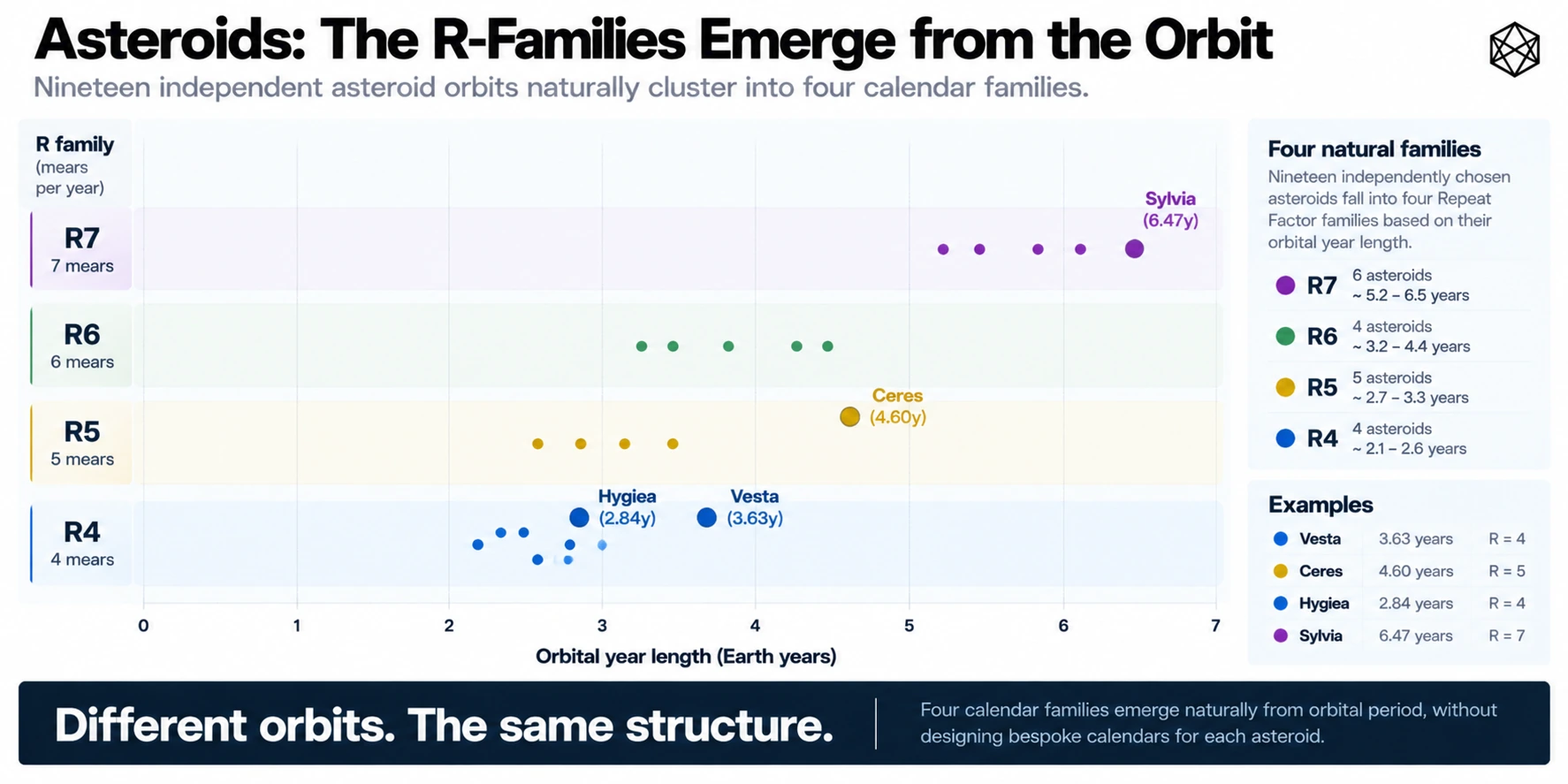
The answer is considerably simpler than nineteen unrelated designs.
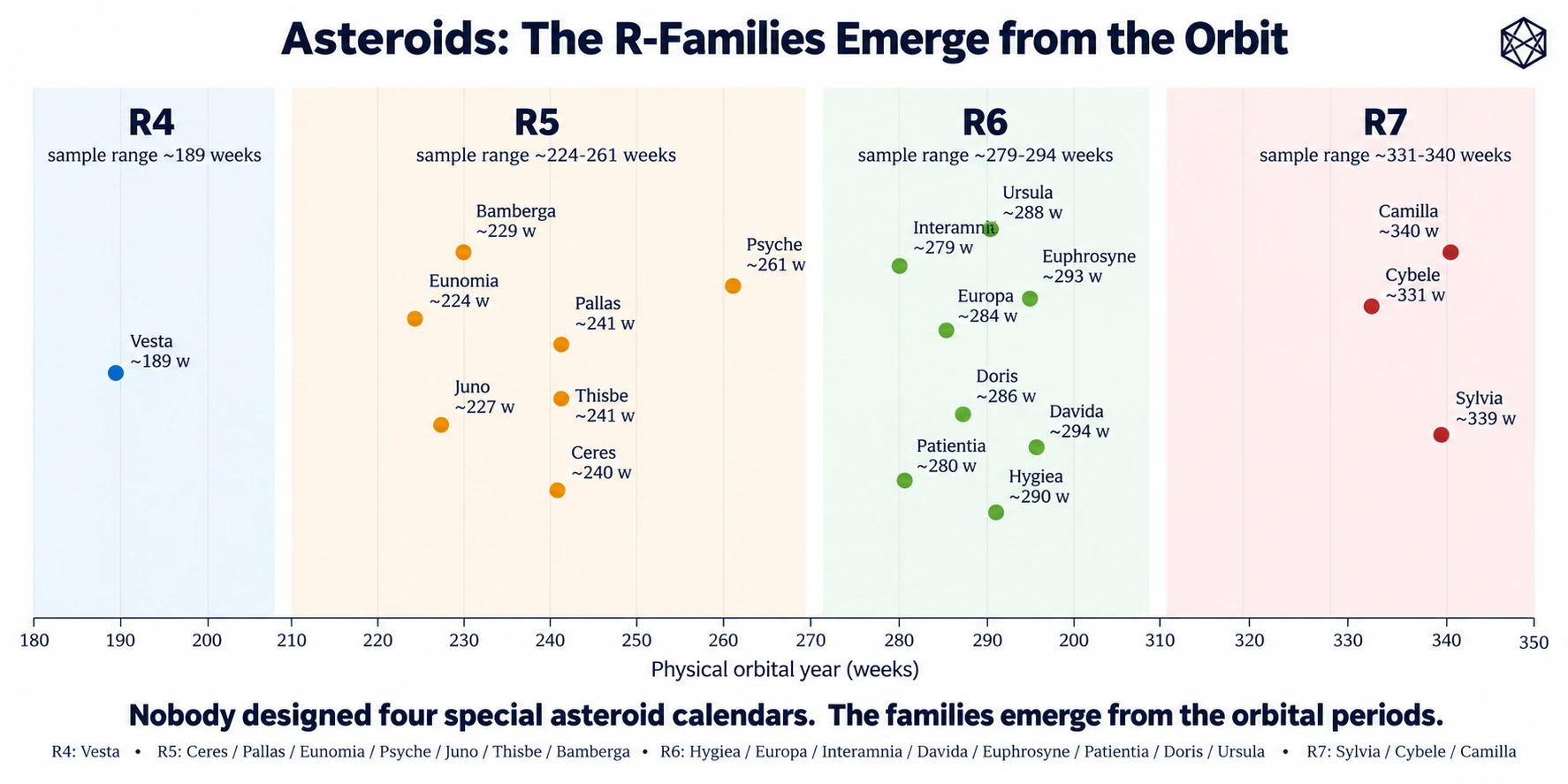
Divide each body's orbital period by the normal 48-week scale of a mear and select the nearest useful synchronized integer Repeat Factor. The nineteen bodies collapse into only four groups:
| Solarian calendar family | Approximate year range in sample | Asteroids in sample | Canonical example |
|---|---|---|---|
| R4 | ~189 weeks | Vesta | Vesta |
| R5 | ~224–261 weeks | Ceres · Pallas · Eunomia · Psyche · Juno · Thisbe · Bamberga | Ceres |
| R6 | ~279–294 weeks | Hygiea · Europa · Interamnia · Davida · Euphrosyne · Patientia · Doris · Ursula | Hygiea |
| R7 | ~331–340 weeks | Sylvia · Cybele · Camilla | Sylvia |
These are Solarian calendar families, not asteroid families in the astronomical sense. Astronomers use that term for groups of objects thought to share a common collisional origin; here it means only that several worlds share the same Repeat Factor.
An R6 asteroid therefore contains six operating mears per orbital year and six minths per orbital month. An R7 asteroid contains seven of each.
Nobody designed four special asteroid calendars in advance. The families emerge from the orbital periods.
That is the first important result of the population test.
Same family does not mean identical calendar
A shared Repeat Factor gives two worlds the same calendar skeleton, not necessarily the same detailed intercalation schedule.
Ceres and Psyche are both R5. Both therefore contain five mears per year, five minths per orbital month and sixty minths per orbital year. But Ceres has an orbital year of roughly 240 weeks, while Psyche's is closer to 261. Ceres lands almost exactly on the nominal R5 structure.
Psyche does not.
The Repeat Factor defines the architecture. The expansion joints reconcile that architecture with the precise local orbit.
Solarian gives priority to mear-terminal Minth L as the primary expansion joint, with secondary designated minths available when the required correction exceeds that primary capacity. The detailed long-run schedules for all nineteen worlds belong in the technical implementation tables rather than in the narrative here.
For the main argument, one representative from each family is enough.
Four canonical examples
The four families can be seen most clearly by placing their canonical examples alongside one another.
| Family | Canonical world | Physical year | Nominal structure | Common Year | Leap Year | Typical adjustment |
|---|---|---|---|---|---|---|
| R4 | Vesta | ~189.4 weeks | 192 weeks | 190 weeks | 189 weeks | Contract 2 or 3 Minth L positions |
| R5 | Ceres | ~240.2 weeks | 240 weeks | 240 weeks | 241 weeks | None, or final Minth L +1 week |
| R6 | Hygiea | ~290.3 weeks | 288 weeks | 290 weeks | 291 weeks | Expand 2 or 3 Minth L positions |
| R7 | Sylvia | ~338.9 weeks | 336 weeks | 338 weeks | 339 weeks | Expand 2 or 3 Minth L positions |
The purpose of these examples is not to introduce four more calendar systems.
It is to show the same protocol landing at four neighbouring scales.
R4 - Vesta's Solarian Calendar
Vesta is the only R4 body in the sample and one of the most physically planet-like asteroids. NASA's Dawn mission revealed a differentiated body with a crust, mantle and core, enormous impact basins and a geological history rather more complicated than the phrase space rock suggests.
Its year lasts about 189.4 standard weeks. Four normal 48-week mears would occupy 192 weeks, so Vesta naturally becomes:
VESTA = R4
The nominal structure is slightly too long. Its 190-week Common Year therefore contracts two mear-terminal Minth L positions, while the 189-week Leap form contracts three.
In one line:
Vesta is R4 — four minths per orbital month and four operating mears per Vestan year.
| Solarian element | Vestan implementation |
|---|---|
| Civil day | 86,400 standard seconds |
| Week | 7 standard days |
| Repeat Factor | R4 |
| Orbital months | 12 — Janves to Decves |
| Operating mears per orbital year | 4 |
| Minths per orbital month | 4 |
| Minths per orbital year | 48 |
| Mean physical orbital year | ~189.4 weeks |
| Common Year | 190 weeks = 48 minths = 12 months |
| Leap Year | 189 weeks = 48 minths = 12 months |
| Long-run year balance | roughly 2 Common : 3 Leap |
| Nominal unadjusted year | 192 weeks (4 × 48) |
| Common Year minth pattern | (46 × 4-week minths) + (2 × 3-week minths) = 190 weeks Two mear-terminal Minth Ls shortened to 3 weeks. 47 · 48 · 47 · 48 weeks by mear |
| Leap Year minth pattern | (45 × 4-week minths) + (3 × 3-week minths) = 189 weeks Three mear-terminal Minth Ls shortened to 3 weeks. 47 · 48 · 47 · 47 weeks by mear |
| Common Year month pattern | (10 × 16 weeks) + (2 × 15 weeks) = 190 weeks 16 · 16 · 15 · 16 · 16 · 16 · 16 · 16 · 15 · 16 · 16 · 16 |
| Leap Year month pattern | (9 × 16 weeks) + (3 × 15 weeks) = 189 weeks 16 · 16 · 15 · 16 · 16 · 16 · 16 · 16 · 15 · 16 · 16 · 15 |
| Year structure | 4 complete operating mears through Janves–Decves |
R5 - Ceres' Solarian Calendar
The R5 family is much larger, containing Ceres, Pallas, Eunomia, Psyche, Juno, Thisbe and Bamberga despite orbital periods spanning nearly forty weeks.
Ceres is the obvious canonical example because its orbit lands extraordinarily close to the nominal R5 structure. Its physical year is about 240.2 weeks, while five ordinary 48-week mears provide exactly:
5 × 48 = 240 weeks
So Ceres, like Saturn, almost perfectly synchronizes.
A 240-week Common Year needs no adjustment at all. The 241-week Leap form needs only one additional week in the final Minth L.
Ceres is R5 — five minths per orbital month and five operating mears per Cererian year.
The important point is not that every R5 asteroid is equally tidy.
They are not.
It is that they retain the same R5 architecture even when the detailed intercalation becomes less convenient.
| Solarian element | Cererian implementation |
|---|---|
| Civil day | 86,400 standard seconds |
| Week | 7 standard days |
| Repeat Factor | R5 |
| Orbital months | 12 — Jancer to Deccer |
| Operating mears per orbital year | 5 |
| Minths per orbital month | 5 |
| Minths per orbital year | 60 |
| Mean physical orbital year | ~240.2 weeks |
| Common Year | 240 weeks = 60 minths = 12 months |
| Leap Year | 241 weeks = 60 minths = 12 months |
| Long-run year balance | roughly 4 Common : 1 Leap |
| Nominal unadjusted year | 240 weeks (5 × 48) |
| Common Year minth pattern | 60 × 4-week minths = 240 weeks No expansion-joint adjustment required. 5 mears × 48 weeks |
| Leap Year minth pattern | (59 × 4-week minths) + (1 × 5-week minth) = 241 weeks The final Minth L of Mear 5 expands to 5 weeks. 48 · 48 · 48 · 48 · 49 weeks by mear |
| Common Year month pattern | 12 × 20 weeks = 240 weeks 20 · 20 · 20 · 20 · 20 · 20 · 20 · 20 · 20 · 20 · 20 · 20 |
| Leap Year month pattern | (11 × 20 weeks) + (1 × 21 weeks) = 241 weeks 20 · 20 · 20 · 20 · 20 · 20 · 20 · 20 · 20 · 20 · 20 · 21 |
| Year structure | 5 complete operating mears through Jancer–Deccer |
R6 - Hygiea's Solarian Calendar
The largest family in the sample is R6. Hygiea, Europa, Interamnia, Davida, Euphrosyne, Patientia, Doris and Ursula all fall into it, with years broadly clustered around 280 to 294 weeks.
The nominal R6 structure is:
6 × 48 = 288 weeks
Hygiea's physical year is roughly 290.3 weeks, so its Common and Leap forms expand two or three mear-terminal Minth L positions respectively.
Hygiea is R6 — six minths per orbital month and six operating mears per Hygiean year.
The family also illustrates why the Repeat Factor is not a complete calendar specification. Ursula lies almost exactly on the nominal 288-week structure, while Davida and Euphrosyne are several weeks longer and Interamnia and Patientia several weeks shorter.
They remain recognisably R6.
| Solarian element | Hygiean implementation |
|---|---|
| Civil day | 86,400 standard seconds |
| Week | 7 standard days |
| Repeat Factor | R6 |
| Orbital months | 12 — Janhyg to Dechyg |
| Operating mears per orbital year | 6 |
| Minths per orbital month | 6 |
| Minths per orbital year | 72 |
| Mean physical orbital year | ~290.3 weeks |
| Common Year | 290 weeks = 72 minths = 12 months |
| Leap Year | 291 weeks = 72 minths = 12 months |
| Long-run year balance | roughly 7 Common : 3 Leap |
| Nominal unadjusted year | 288 weeks (6 × 48) |
| Common Year minth pattern | (70 × 4-week minths) + (2 × 5-week minths) = 290 weeks Two mear-terminal Minth Ls expanded to 5 weeks. 48 · 49 · 48 · 49 · 48 · 48 weeks by mear |
| Leap Year minth pattern | (69 × 4-week minths) + (3 × 5-week minths) = 291 weeks Three mear-terminal Minth Ls expanded to 5 weeks. 48 · 49 · 48 · 49 · 48 · 49 weeks by mear |
| Common Year month pattern | (10 × 24 weeks) + (2 × 25 weeks) = 290 weeks 24 · 24 · 24 · 25 · 24 · 24 · 24 · 25 · 24 · 24 · 24 · 24 |
| Leap Year month pattern | (9 × 24 weeks) + (3 × 25 weeks) = 291 weeks 24 · 24 · 24 · 25 · 24 · 24 · 24 · 25 · 24 · 24 · 24 · 25 |
| Year structure | 6 complete operating mears through Janhyg–Dechyg |
R7 - Sylvia's Solarian Calendar
The final family contains Sylvia, Cybele and Camilla, all large bodies in the outer part of the Main Belt approaching three and a half astronomical units from the Sun.
Sylvia is a useful canonical example because it is itself a small system, with two known moons, Romulus and Remus. Its orbital year is about 338.9 weeks.
Seven normal mears provide:
7 × 48 = 336 weeks
so Sylvia becomes:
SYLVIA = R7
Its Common and Leap forms require two or three expanded Minth L positions, producing 338- and 339-week years.
Sylvia is R7 — seven minths per orbital month and seven operating mears per Sylvian year.
| Solarian element | Sylvian implementation |
|---|---|
| Civil day | 86,400 standard seconds |
| Week | 7 standard days |
| Repeat Factor | R7 |
| Orbital months | 12 — Jansyl to Decsyl |
| Operating mears per orbital year | 7 |
| Minths per orbital month | 7 |
| Minths per orbital year | 84 |
| Mean physical orbital year | ~338.9 weeks |
| Common Year | 338 weeks = 84 minths = 12 months |
| Leap Year | 339 weeks = 84 minths = 12 months |
| Long-run year balance | roughly 1 Common : 10 Leap |
| Nominal unadjusted year | 336 weeks (7 × 48) |
| Common Year minth pattern | (82 × 4-week minths) + (2 × 5-week minths) = 338 weeks Two mear-terminal Minth Ls expanded to 5 weeks. 48 · 48 · 49 · 48 · 48 · 49 · 48 weeks by mear |
| Leap Year minth pattern | (81 × 4-week minths) + (3 × 5-week minths) = 339 weeks Three mear-terminal Minth Ls expanded to 5 weeks. 48 · 48 · 49 · 48 · 48 · 49 · 49 weeks by mear |
| Common Year month pattern | (10 × 28 weeks) + (2 × 29 weeks) = 338 weeks 28 · 28 · 28 · 28 · 28 · 29 · 28 · 28 · 28 · 28 · 29 · 28 |
| Leap Year month pattern | (9 × 28 weeks) + (3 × 29 weeks) = 339 weeks 28 · 28 · 28 · 28 · 28 · 29 · 28 · 28 · 28 · 28 · 29 · 29 |
| Year structure | 7 complete operating mears through Jansyl–Decsyl |
Across the four examples, nothing fundamental has changed.
Only the integer.
The synchronized architecture moves from Vesta's R4 through R5 and R6 to the outer-belt R7 bodies without introducing a new human unit or a new calendar grammar.
That is the result the worked examples are there to demonstrate. These four paired Common and Leap forms are worked reference constructions. They show the adjustment mechanism, not every possible astronomical year length. A complete implementation requires its dated, versioned year-form catalogue, including any additional adjustments demanded by the orbit.
Where the primary expansion joints are not enough
The four canonical examples are deliberately clean.
Not every asteroid lands so politely near the nominal centre of its Repeat-Factor family.
Psyche is the clearest example. Its R5 skeleton contains:
5 × 48 = 240 weeks
while its physical orbit is about:
261 weeks
The five primary mear-terminal Minth L positions can provide only five additional weeks if each expands once.
That is not enough.
Psyche therefore uses the secondary expansion joints already allowed by the protocol for the remaining correction. It remains R5: five mears per year, five minths per orbital month and sixty minths per orbital year.
The additional flexibility is needed because small-body orbital periods occupy a continuous range rather than arranging themselves conveniently around multiples of forty-eight weeks.
The principle remains simple:
Use the primary expansion joints first; add designated secondary joints where the astronomy requires them.
The exact placement belongs in the implementation tables rather than twenty pages of asteroid arithmetic.
This gives the population test a second useful result.
The Repeat Factor families remain stable even when their individual members need substantially different intercalation.
Where the astronomical layer becomes less clean
The population test also exposes a more important limitation.
The problem is not the human operating calendar. Weeks, minths and mears remain perfectly usable on all nineteen bodies, and each can be assigned a straightforward R4, R5, R6 or R7 operating skeleton.
The harder issue is the astronomical month.
Solarian's standard astronomical layer treats twelve civil orbital months as a useful coarse representation of progress around the local heliocentric orbit. That approximation works naturally on low- and moderately eccentric paths.
As eccentricity increases, however, the body moves substantially faster near perihelion and slower near aphelion. Equal periods of elapsed time then correspond to increasingly unequal movement around the Sun.
At some point, twelve roughly similar-duration civil months stop being a sufficiently good proxy for orbital phase.
The early screening suggested a small number of difficult cases. A subsequent historical calculation using a fixed expansion-joint rule has made that picture more precise, but not quite so tidy. Some of the bodies that first appeared to be clean standard cases require individual review when their month boundaries are tested against actual orbital positions. Others remain better candidates for a specialised astronomical representation.
Bamberga and Juno illustrate the more difficult end of the spectrum. Their synchronized human calendars can still operate on the ordinary week–minth–mear structure, while the twelve nominal orbital-month labels can depart too far from the actual angular position to serve as reliable guides. In those cases, the astronomical display needs a different solution; the human calendar does not.
Interamnia was already close to the boundary. Further historical screening also brings Pallas, Davida, Psyche, Thisbe and Eunomia into the group requiring closer individual assessment. Eunomia is particularly instructive: the bounded calculation places it within a marginal review band, although a deliberately conservative specialised treatment may ultimately be appropriate. No such profile decision should be made simply from an eccentricity figure or a preliminary screening label.
Orbital eccentricity matters, but it does not determine the outcome by itself. The orientation of perihelion, the shared 100° reference direction and the fixed location of civil month boundaries all contribute. Pallas once changed sides of the standard threshold under two admissible candidate joint-placement arrangements. That is why the adjustment rule must be selected independently of the result it is later asked to measure.
The lesson is not that difficult asteroid orbits invalidate Solarian. It is that a useful civil structure and a faithful astronomical representation are two separate claims, each requiring its own evidence.
A calendar that works — and an orbit that must be tested
The nineteen-body sample continues to demonstrate four common operating families. What cannot be decided from that fact alone is whether the standard twelve-month astronomical layer is suitable for each individual orbit. The available historical evidence suggests three distinct routes:
| Astronomical disposition | Meaning for the proposed profile | Review status |
|---|---|---|
| Standard potential | Twelve civil orbital months satisfy the declared phase metric in the bounded historical screen. | No final contemporary certification implied |
| Marginal review | Pallas, Interamnia, Davida, Eunomia, Psyche and Thisbe require individual applicability decisions. | No automatic standard approval or forced failure |
| Specialised treatment | Juno and Bamberga need a different astronomical phase display while the operating structure remains available. | No specialised display selected or approved |
The sample was not chosen for conveniently circular orbits. These worlds differ in size, composition, inclination, eccentricity and orbital period, and their eventual importance to human settlement may have little relationship to their present familiarity. The common operating structure survives this diversity, but claims about angular phase require a declared astronomical source, an evaluation window and exact month-boundary rules.
A bounded archival screen is useful evidence, not a permanent population census. It does not yet establish contemporary orbit-model certification, and the additional asteroid year forms used for many of the historical dates remain unratified. The numerical results and their limitations belong in the supporting technical record rather than in a headline claiming final applicability for every asteroid.
That distinction is not an embarrassment. It is what a protocol with a genuine applicability boundary is supposed to reveal.
What the asteroid belt tells us
The major planets showed that Solarian can scale.
The asteroid belt shows that it can generalise.
Nineteen independent bodies, spanning significantly different orbital periods and eccentricities, do not produce nineteen unrelated calendar architectures. Their synchronized human structures collapse into only four families:
R4 · R5 · R6 · R7
That is the most important result of the chapter.
A traveller moving from Ceres to Pallas would encounter different local intercalation schedules, but both calendars would remain recognisably R5. Moving to Hygiea changes that to R6. Moving to Sylvia changes it to R7.
The local details vary.
The grammar does not.
The population test also reveals two limits to that neatness. Some members of a family require secondary expansion joints because their orbital periods sit farther from the nominal centre of the family. More importantly, sufficiently awkward orbital geometry can cause the standard twelve-month astronomical representation to lose the phase fidelity it was supposed to provide.
Those are not inconvenient results to be hidden.
They are part of the evidence.
The asteroid belt therefore makes the division of responsibility within Solarian clearer than any single planet could.
The mear belongs to people and operations.
The year belongs to the orbit.
And the standard orbital-month layer belongs only where it remains a useful representation of that orbit.
A protocol that claims to work everywhere should make us suspicious. A protocol that works cleanly across most ordinary cases, identifies why some do not and allows its human operating layer to survive when the astronomical layer needs special treatment is much more useful.
The Main Belt therefore gives Solarian both a success and a limit. Four operating families provide a common grammar across this varied sample, while the astronomical-month representation must be evaluated on each orbit's merits. Some implementations can use the standard form; others require individual judgement or a specialised astronomical display.
That seems a reasonable outcome for a region containing millions of independent worlds.
The next chapter changes the question completely.
Asteroids inherit their orbits from nature.
Artificial worlds do not necessarily have to.