GRID
9) One Week for the Solar System
The Solarian Week Index
By this point, the main machinery of Solarian is in place.
People have a recurring operating calendar built from weeks, minths and mears. Worlds have local astronomical calendars built from twelve orbital months and one heliocentric year. Where those two structures can be synchronized, the Repeat Factor connects them, while the previous chapter established that Solarian builds and adjusts its civil calendars in complete weeks.
That last decision has a useful consequence. For settlements using the standard 86,400-second civil day, the week need not merely be the same kind of unit.
It can be the same continuing week.
The Solar System does not need one calendar.
It can share one week.
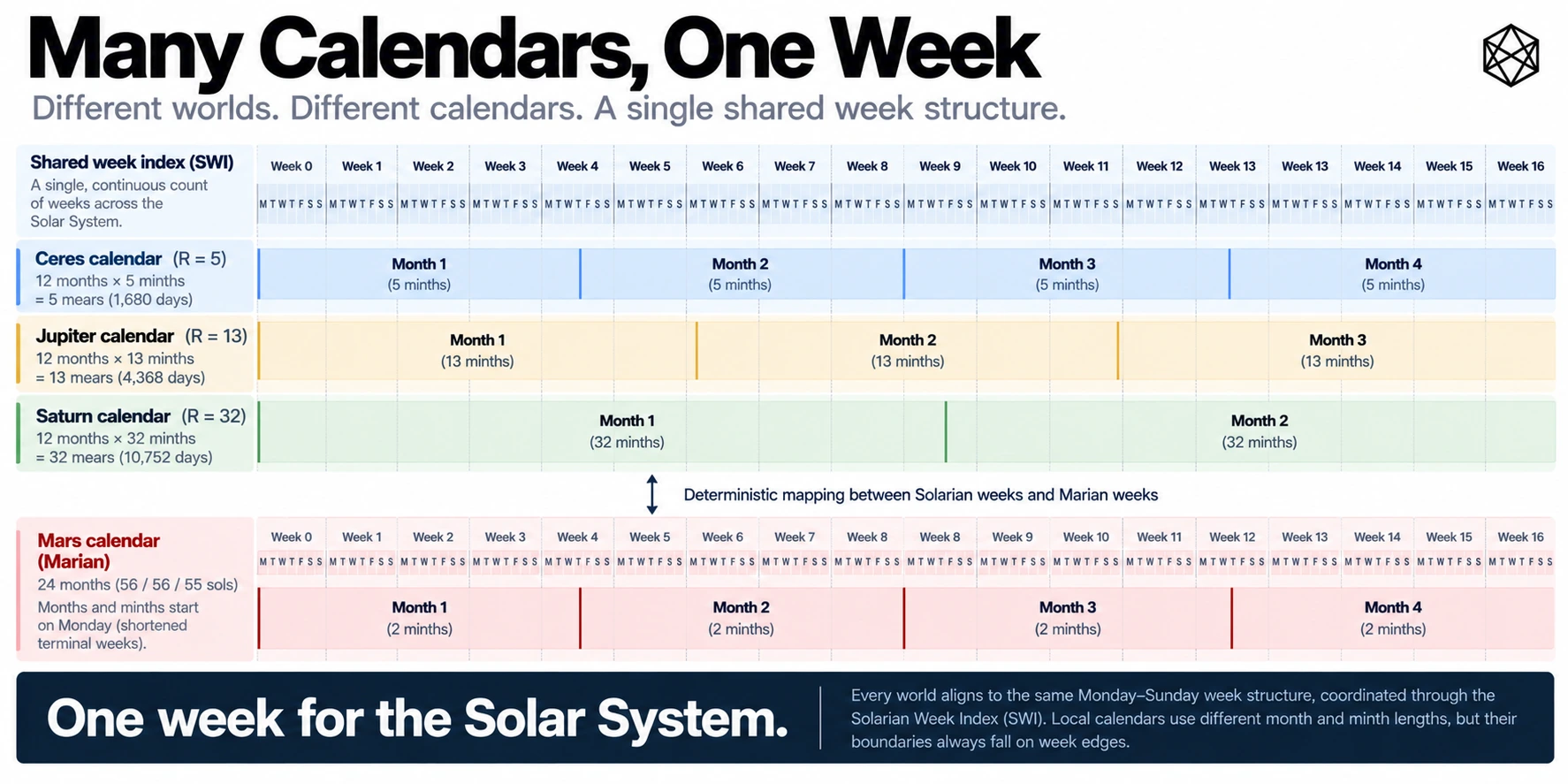
One continuous weekly grid
Solarian gives standard-day settlements one uninterrupted seven-day civil sequence:
Monday → Tuesday → Wednesday → Thursday → Friday → Saturday → Sunday → Monday…
It does not restart at New Year, pause between minths or insert stray days outside the weekly cycle. Because orbital months, mears and minths are all constructed from complete weeks, their boundaries can be placed onto that continuing sequence without disturbing it.
Ceres may begin a new orbital month while Jupiter is halfway through a completely different one. Saturn may be in another local year altogether.
The dates differ.
The underlying standard week does not.
For standard-day settlements, Tuesday on Ceres is therefore the same weekday position as Tuesday in the Jovian or Saturnian systems. Their local civil calendars are different structures drawn over one common weekly foundation.
The useful mental model is a sheet of graph paper beneath them. Each cell represents one complete seven-day week. Ceres draws its month and year boundaries on some of those lines, Jupiter draws different ones and Neptune draws others much farther apart.
Nobody draws halfway through a cell.
The grid underneath remains common.
Counting the weeks
Once that shared weekly sequence exists, the obvious next step is simply to count it.
Choose one agreed reference epoch and number each successive standard week:
… 18,430 → 18,431 → 18,432 → 18,433 → 18,434 …
That number is the Solarian Week Index, or SWI.
Its job is deliberately modest. A SWI value does not tell us which Cererian orbital month is current, where Saturn sits in its year or which local minth somebody is using.
It answers one question:
Which shared standard week is this?
That is all.
And that is why it is useful.
A coordinate, not another calendar
The Solarian Week Index is not a third Solarian calendar. It has no months, seasons, years, holidays or cultural vocabulary, and nobody needs to celebrate SWI 18,432 unless future civilisation develops a surprisingly enthusiastic standards community.
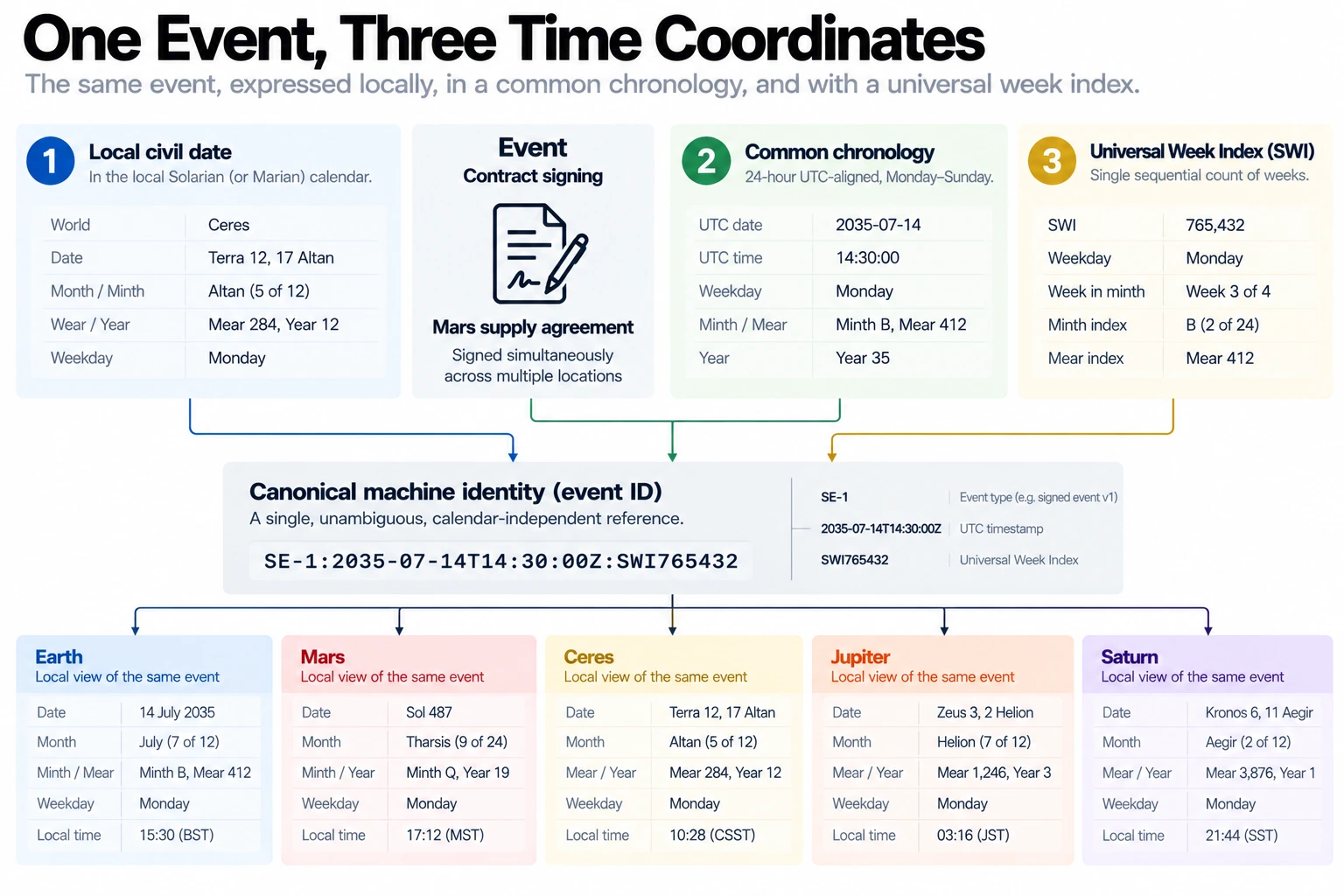
The SWI is better understood as a coordinate. A geographical coordinate does not replace the name of a city, and a kilometre marker does not replace a street address. In the same way, a Solarian Week Index does not replace a Cererian, Jovian or Saturnian date.
It gives those dates a common weekly reference underneath.
Suppose the shared week is SWI 18,432. On Ceres, that week might fall in one minth of one orbital month. Around Jupiter, the same seven-day interval occupies a completely different position within the R13 calendar, while Saturn places it somewhere else again.
All three local dates can be correct.
The SWI simply tells us that underneath those different local descriptions lies the same standard week.
That distinction matters because Solarian already has enough calendar units. A useful number does not automatically deserve its own hierarchy.
Why the shared week matters
A common weekly coordinate becomes useful whenever activity crosses local calendars.
A maintenance programme might have teams on Ceres and Ganymede, each planning internally using its own local months and minths. A cross-system review can nevertheless be assigned to one Universal Week without either team abandoning its local calendar.
Software and records benefit even more. A monotonically increasing week count is exceptionally easy to compare, sort and store. It does not care whether one settlement uses R5 and another R32, nor does it need to understand whatever cultural names those societies eventually give their calendar periods.
The local civil calendar remains the human interface.
The SWI becomes part of the plumbing.
This is exactly the kind of interoperability Solarian is intended to provide: not identical calendars, but a small amount of common structure underneath them.
The Monday Rule, seen differently
The previous chapter established that every major Solarian civil boundary begins on the first weekday. For standard-day settlements, those first weekdays are not merely equivalent local positions. They belong to the same continuous weekday phase.
A new Cererian orbital month may therefore begin on a Monday that is completely ordinary in the Jovian system. Jupiter does not begin a new month at the same moment, but both settlements occupy the same Monday-to-Sunday sequence underneath their local calendars.
The month boundaries differ.
The weekday phase does not.
This gives radically different astronomical calendars a surprisingly familiar common surface. A Neptunian orbital month may last well over a decade in terrestrial terms, while a Cererian month is much shorter and Mercury's astronomical months eventually become shorter than an ordinary human minth.
Those differences belong to the worlds.
The recurring standard week can belong to humanity collectively.
Local names remain local
A common weekly phase does not require everybody to call the weekdays Monday, Tuesday and Wednesday. Different languages already use different names on Earth, and future settlements may develop entirely new ones. Solarian only requires the seven structural positions to correspond and the sequence to continue without interruption.
“Monday” is therefore a convenient reference label for the first weekday.
The name can change.
The position underneath does not.
This is another instance of the same protocol principle:
Common structure; local culture.
Mars maps to the grid
Mars requires one important qualification.
Its civil day is the Martian sol rather than the standard 86,400-second day. Seven sols therefore produce a Martian week that is physically a little longer than the common seven-standard-day week.
Mars cannot consequently remain permanently phase-locked to the standard-day weekly lattice. Its local weekday sequence gradually drifts in physical time relative to Ceres, Jupiter, Saturn and other standard-day settlements.
That does not require a different calendar grammar. Mars still uses seven-position weeks, complete-week minths and the same larger Solarian structure. It simply needs a deterministic mapping between its local sol-based week and the Solarian Week Index.
The technical conversion belongs in the specification.
The useful mental model is:
Standard-day settlements share the Solarian Week directly. Mars maps to it.
Not a universal timezone
Sharing a week does not mean sharing a local hour.
One settlement may be asleep while another is working. Artificial habitats can choose their own lighting and shift patterns, while local environmental cycles on moons may bear little relationship to a twenty-four-hour terrestrial day.
The SWI does not attempt to solve any of that.
It operates at weekly resolution. That coarseness is deliberate. Solarian is providing a common civil planning coordinate, not attempting to turn the Solar System into one enormous timezone.
A very boring number
There is something pleasingly unromantic about the Solarian Week Index.
The astronomical calendar deals with worlds moving around the Sun. The Repeat Factor reveals neat relationships between human cadence and enormous orbital cycles, while expansion joints absorb the inconvenient arithmetic of real astronomy.
The SWI is just a counter.
Week 18,430.
Week 18,431.
Week 18,432.
Nothing could be much less poetic.
That is precisely why databases, project plans and standards tend to like things like it.
Infrastructure often improves as it becomes more boring.
The completed Solarian model
The conceptual architecture introduced through Part II can now be reduced to four statements:
Every world has its own orbital calendar.
Every settlement has a human operating calendar.
Standard-day settlements share one continuous week.
The Solarian Week Index simply counts those weeks.
The first two give communities locally meaningful civil time. The third creates a common weekly foundation. The fourth gives machines, travellers and cross-world organisations a simple coordinate for referring to it.
The precise epoch, formal notation, machine representation and Mars conversion rules belong in the technical specification rather than the narrative here.
What matters before we turn to actual worlds is the architecture.
Solarian calendars are not identical.
They are not floating independently in time either.
They are different local calendars sitting on a shared human framework.
Now we can see what happens when that framework meets Mars.