BRIDGE
7) You Only Need One Number
The Repeat Factor
Solarian now has two calendars running alongside one another.
The human calendar provides the recurring operating rhythm:
12 minths = 1 mear
The astronomical calendar describes the local orbit:
12 orbital months = 1 year
The Repeat Factor, written R, is the number that connects those two structures when they can be cleanly synchronised. Its definition is:
R = minths per orbital month = mears per orbital year
That relationship is one of the central ideas in Solarian.
Twelve and twelve
The easiest way to understand the Repeat Factor is to keep both calendars visible.
If R = 2, each orbital month [one twelfth of a year] contains two minths [2 four-week periods].
Also if R = 2, the complete orbital year contains two mears [12 minths of four-weeks, i.e. 48 weeks].
If R = 5, each orbital month contains five minths and the year contains five mears. And so on.
The same number describes the relationship at both scales because both sides of the architecture contain twelve recurring positions:
PEOPLE
12 minths = 1 mear
PLANET
12 months = 1 year
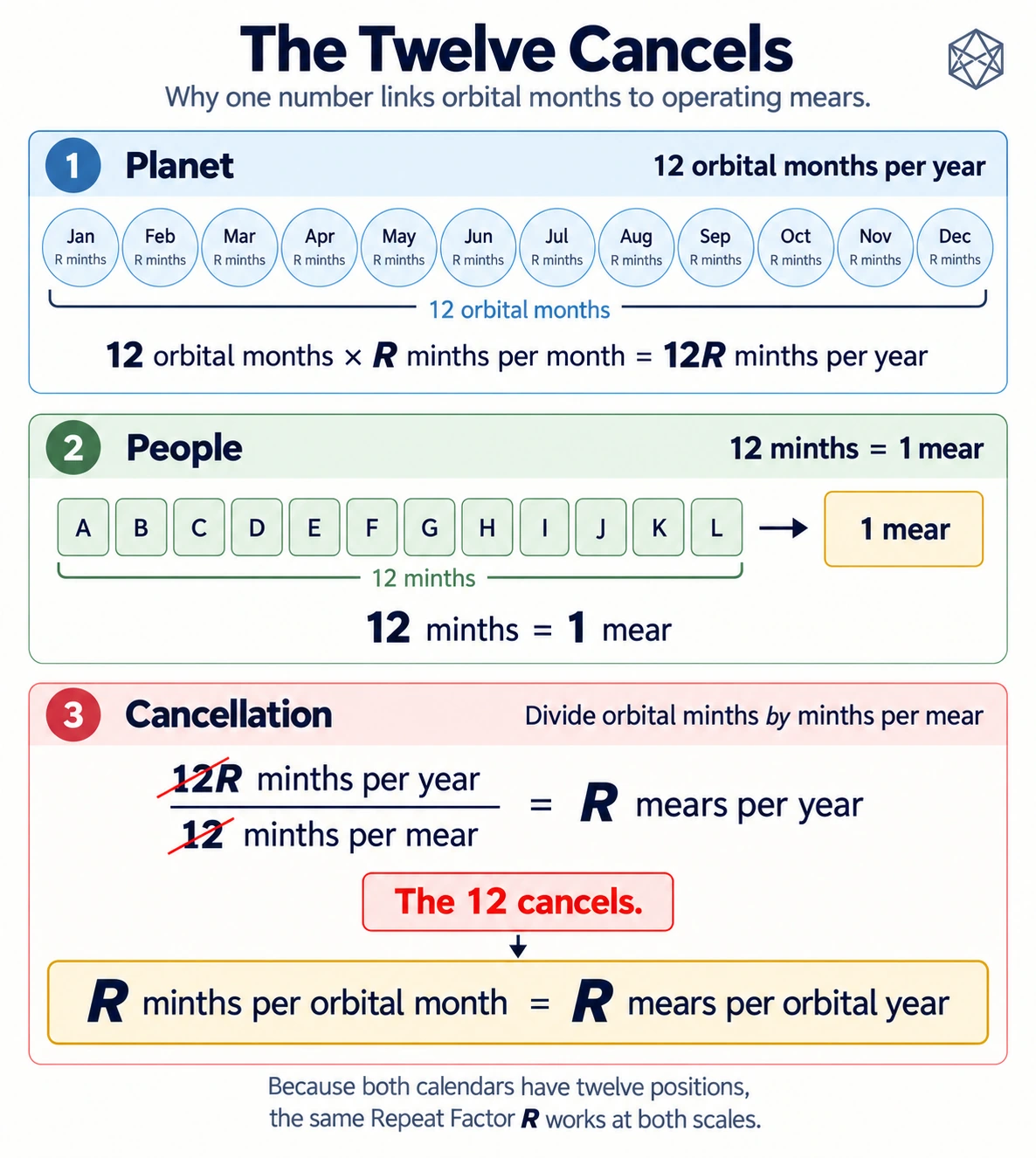
That symmetry does something surprisingly useful. If each of the twelve orbital months contains R minths, the complete year contains 12R minths. But twelve minths make one mear, so those 12R minths are also exactly R mears.
In other words:
The twelve cancels.
Twelve minths per mear. Twelve orbital months per year. The same whole number therefore tells us both how many minths fit inside an orbital month and how many mears fit inside the complete orbital year.
So:
The Repeat Factor tells us how many times the human operating mear repeats within the orbital year.
That is the main thing to remember. Everything else in a synchronized Solarian implementation is largely about keeping those two structures closely aligned with a real orbit that will, inevitably, refuse to fit the arithmetic perfectly.
The calendar scales by repetition
One useful consequence is that increasingly long orbital years do not require increasingly elaborate calendar units.
The human side remains:
Week → Minth → Mear
The astronomical side remains:
Orbital Month → Orbital Year
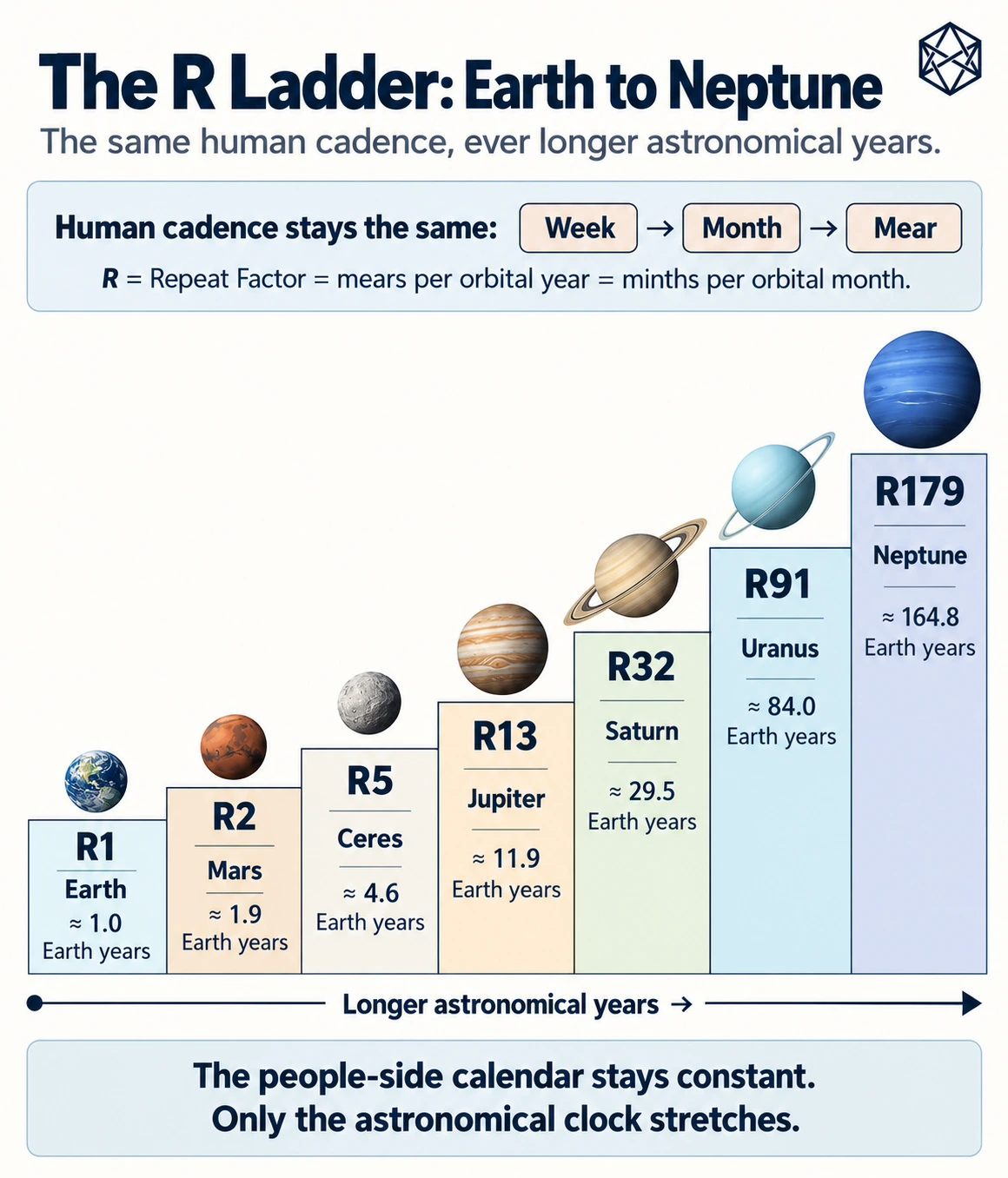
Only the Repeat Factor changes. Mars will turn out to be R2. Ceres is R5. Jupiter reaches R13, Saturn R32, Uranus R91 and Neptune R179.
Those numbers become large, but the calendar itself does not become conceptually larger. An R179 world does not need 179 different kinds of human period. It simply contains 179 repetitions of the same operating mear during one astronomical year.
The calendar grows through repetition rather than through vocabulary.
That is an important part of why the architecture scales.
Synchronized and independent calendars
There is, however, an important limit to the Repeat Factor.
It should not be forced onto a world merely because Solarian happens to contain it.
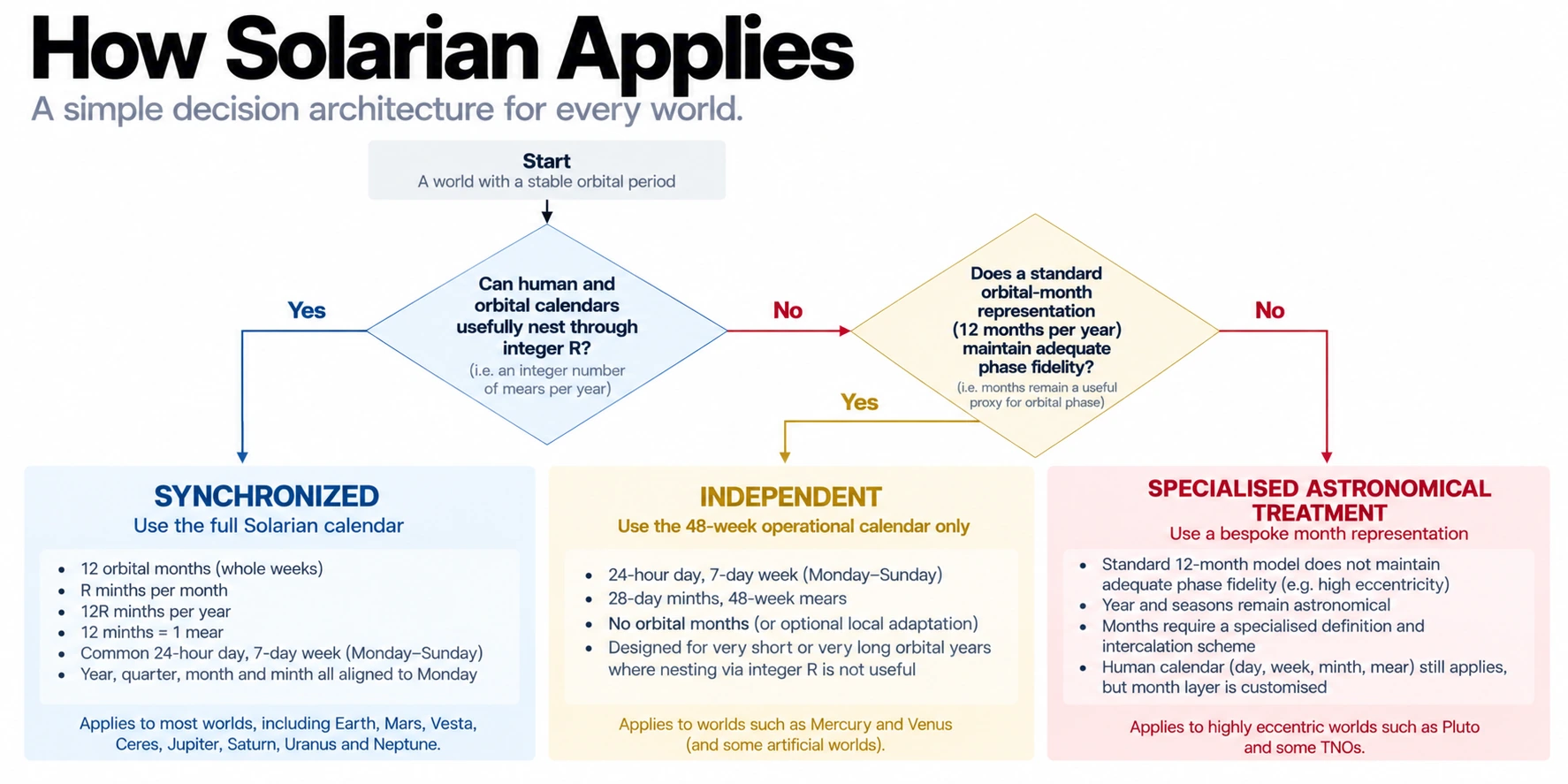
For many destinations — Mars, the asteroids and the outer planetary systems in particular — the human mear can be nested cleanly inside the local orbital year using a whole-number Repeat Factor. These are synchronized Solarian implementations.
In the synchronized regime:
R is always a whole number.
The local orbital year therefore contains a whole number of operating mears, while every orbital month contains the same whole number of minths. This is a remarkably useful relationship where the astronomy allows it.
But not every orbit does.
On sufficiently short-year worlds, most notably Venus and Mercury, forcing an integer number of approximately human-scale mears inside one local orbital year would distort either the astronomical calendar or the human operating rhythm beyond usefulness.
Solarian does not solve that problem by inventing a fractional mear or stretching human cadence until the arithmetic behaves.
The two calendars simply run independently.
The human calendar continues:
Week → Minth → Mear
The astronomical calendar continues:
12 orbital months → 1 local year
But there is no requirement for one to nest inside the other, and therefore no useful Repeat Factor needs to be imposed.
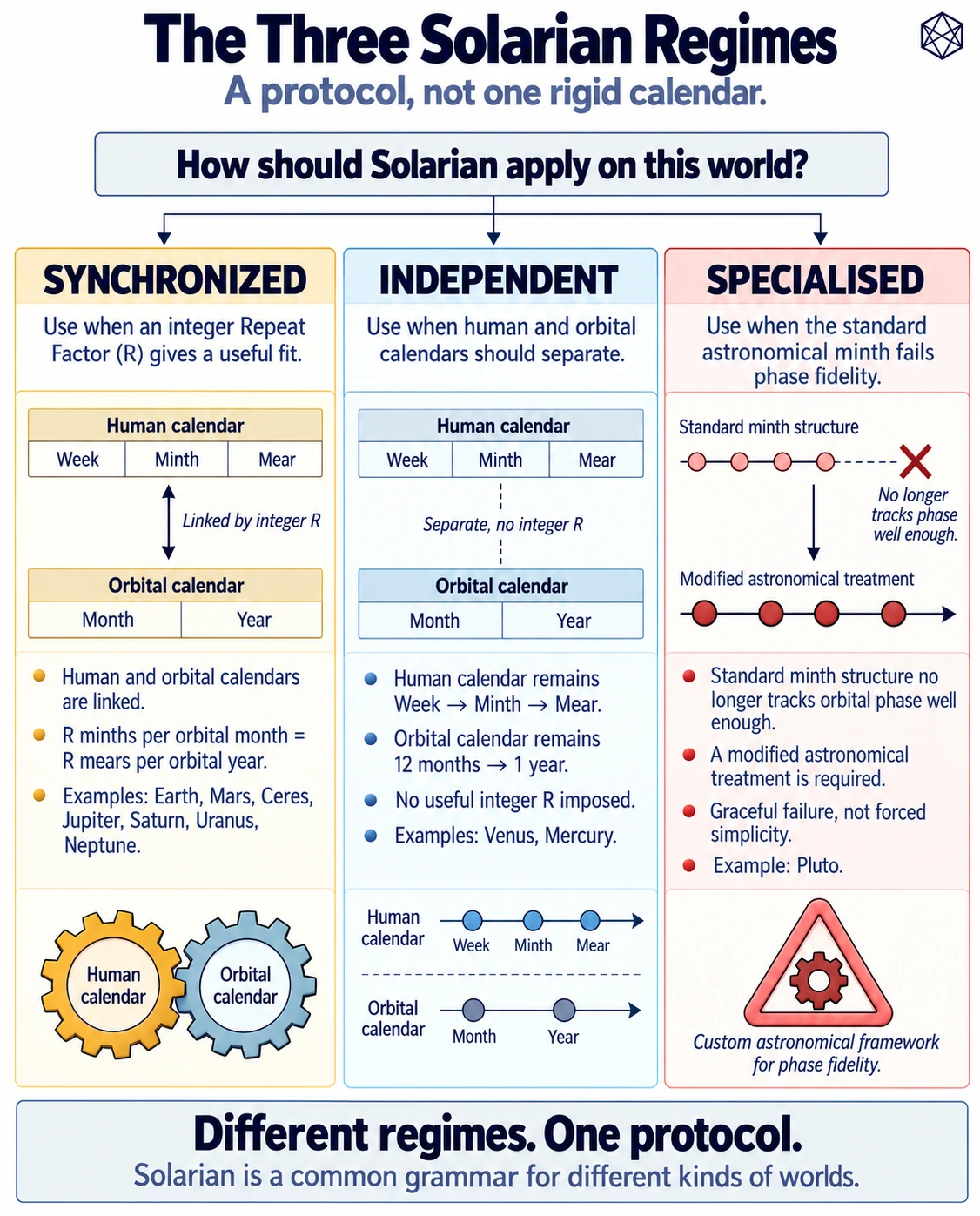
That distinction gives Solarian two legitimate operating regimes:
SYNCHRONIZED
The human and astronomical calendars are connected by an integer Repeat Factor.
INDEPENDENT
The human and astronomical calendars run alongside one another without a nesting relationship.
Neither is an exception to Solarian. They are two ways the same architecture can respond to different astronomy.
Why integer R matters when synchronization works
Where synchronization is practical, keeping R as a whole number preserves a particularly clean property. A local New Year arrives only after a complete number of human operating mears, rather than halfway through one. Likewise, every orbital month contains a complete number of minths.
The boundaries therefore remain structurally intelligible:
R2: 2 minths per month · 2 mears per year
R5: 5 minths per month · 5 mears per year
R13: 13 minths per month · 13 mears per year
The exact durations in weeks will not always fit perfectly because real orbits contain inconvenient fractions.
That is a different problem.
The Repeat Factor establishes the skeleton. The next chapter deals with the adjustment required to make that skeleton follow actual astronomy.
The Repeat Factor is structural, not cultural
R says nothing about what people call their months or minths, which holidays they celebrate, how they number local years or how an organisation chooses to structure its budget. It describes only the structural relationship between the human and astronomical calendars.
A settlement can therefore be described compactly as R2, R5 or R32 while still developing a completely local calendar culture above that architecture.
The number belongs to the protocol.
The lived calendar belongs to the people using it.
The Solarian model so far
At this point, the core architecture can be reduced to four ideas.
Two calendars
People have an operating calendar. Worlds have an astronomical calendar.
Twelve and twelve
Twelve minths make one mear. Twelve orbital months make one year.
Synchronize where it works
Where a clean nesting relationship is useful, an integer Repeat Factor connects the two calendars.
Let them separate where it does not
Where the astronomy makes that relationship unhelpful, the human and astronomical calendars continue independently.
That is almost the complete conceptual architecture. There is only one practical problem left before we start applying it to actual worlds: real orbital years do not arrive in exact numbers of four-week minths.
The structure is clean.
Nature is not.
The next chapter deals with the difference.