CONNECT
23) Dates Become Geography
Time, Distance & the Month-Gap Heuristic
Calendars usually tell us when something happens.
Solarian's orbital calendar can also tell us, very approximately, where worlds are relative to one another.
That was not the original reason for giving local heliocentric calendars a common twelve-position structure. The purpose was to make Month 1, Month 2 and so on describe broadly corresponding portions of each world's journey around the Sun.
But once those positions share a common orientation, something useful emerges.
Dates begin to contain geography.
Not enough geography to navigate a spacecraft. Not enough to calculate an exact communications delay.
Enough, however, to give an ordinary person a rough mental picture of an inhabited Solar System without consulting an ephemeris.
That is a surprisingly useful thing for a calendar to do.
Twelve positions around one Sun
The idea begins with Solarian's common astronomical reference direction.
Where the standard twelve-month orbital layer applies, each local year begins from the same heliocentric orientation and progresses through twelve broadly corresponding positions around the Sun.
Month 1 therefore means approximately the same directional part of the orbit on Mars, Ceres, Jupiter or Saturn. Month 4 represents another. Month 7 lies roughly half an orbit around from Month 1.
The worlds do not occupy those positions at the same time.
Mars moves around the Sun far faster than Jupiter. Ceres completes several orbits during one Saturnian year, while Neptune can remain within one enormous orbital month during years of ordinary human activity elsewhere.
What is shared is not the speed of the clock.
It is the meaning of the positions.
If Mars and Jupiter are both in their respective Month 3, they are broadly travelling through corresponding heliocentric directions. If Mars is in Month 3 and Jupiter in Month 9, their positions are roughly opposite around the common twelve-position clock.
The reference names make this visible:
Janmar · Jancer · Janjov · Jansat
all expose Month 1.
Julmar · Julcer · Juljov · Julsat
all expose the corresponding Month 7 region roughly half an orbit later.
The suffix tells us which world.
The stem gives us a crude indication of where around the Sun.
That was not required for Solarian to work.
But once the structure exists, it is there for free.
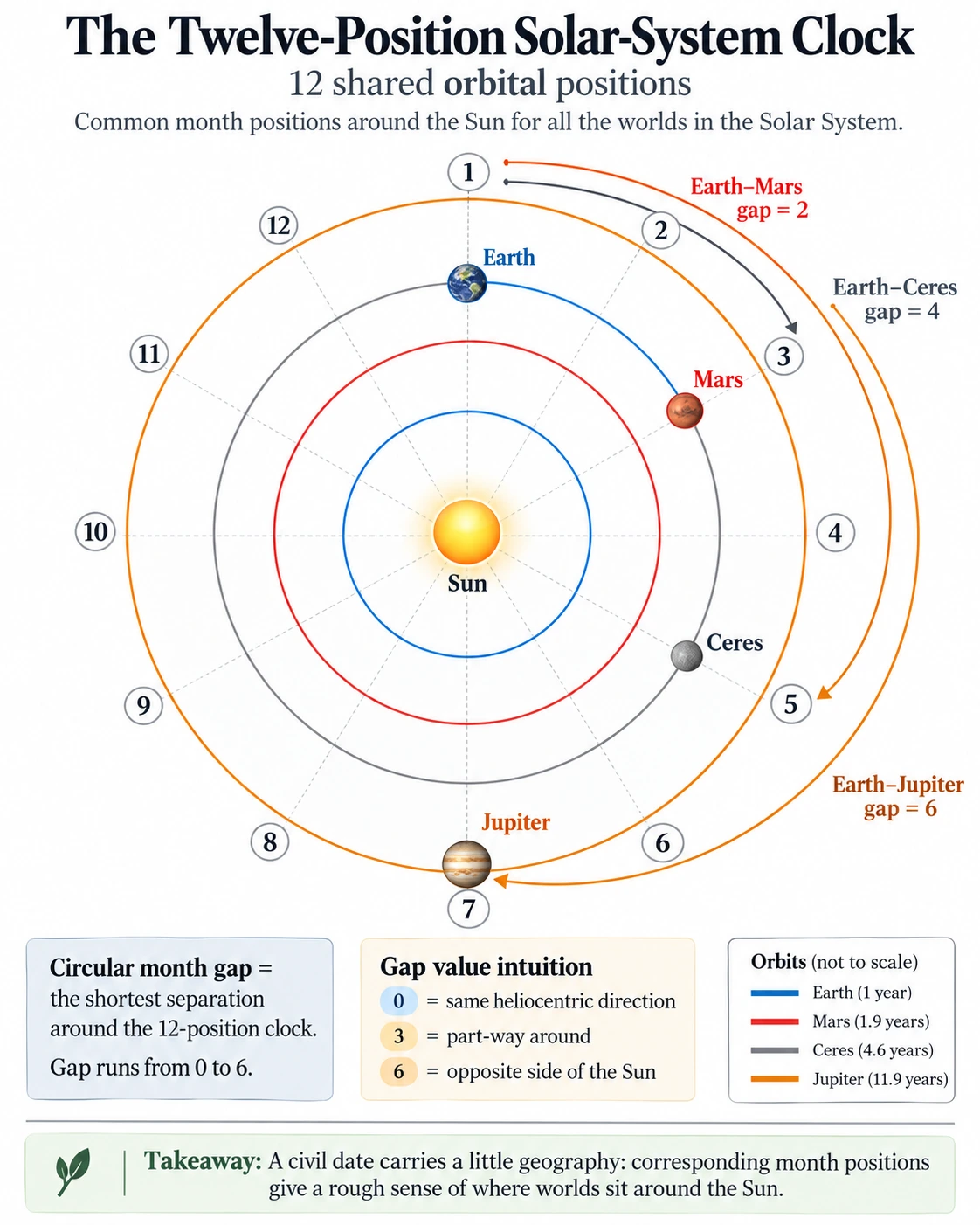
The circular month gap
Comparing two worlds then becomes almost embarrassingly simple.
Take the difference between their orbital-month positions and measure the shortest distance around the twelve-position circle. Because the clock wraps around, the largest possible separation is six positions rather than eleven.
This gives the circular month gap:
| Month gap | Broad orbital interpretation |
|---|---|
| 0 | Corresponding heliocentric directions |
| 1 | Very similar directions |
| 2 | Modest angular separation |
| 3 | Roughly quarter-orbit separation |
| 4 | Broadly separated |
| 5 | Approaching opposite-side geometry |
| 6 | Approximately opposite directions |
Month 12 and Month 1 are neighbours, so their gap is one. Month 11 and Month 1 are two positions apart. Month 1 and Month 7 give the maximum gap of six.
Once orbital months are understood as positions around a circle rather than merely names in a sequence, the idea is almost immediate.
Two dates have become a crude angle.
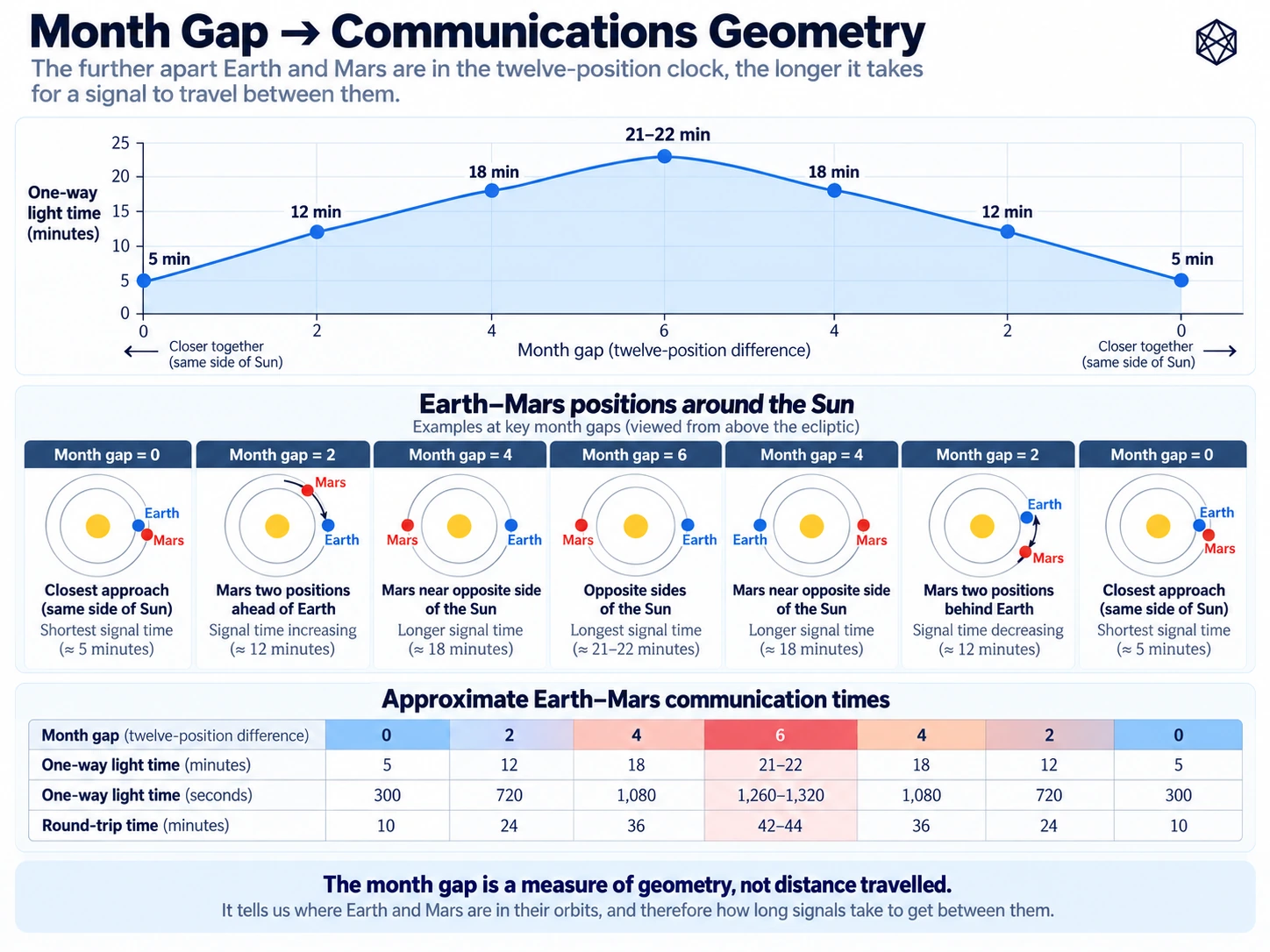
Why that tells us something about distance
Imagine two worlds travelling on perfectly circular orbits.
When they lie in the same heliocentric direction, their distance apart is broadly the difference between their orbital radii. As one moves around the Sun relative to the other, the separation generally increases. At opposite-side geometry, the distance approaches the sum of the two orbital radii.
The circular month gap therefore contains rough information about relative range. For a particular pair of worlds, gap zero tends to correspond to the more favourable end of the distance cycle. Gap six tends towards the less favourable end. The positions in between provide a rough progression between those states.
The phrase for a particular pair matters.
Earth and Neptune at gap zero are still vastly farther apart than Earth and Mars at gap six. The month gap does not turn the Solar System into one universal distance scale.
It gives us the broad geometry within the scale set by the two destinations themselves.
That is a much more useful claim.
A person gradually learns two things together:
Where is the other world in the Solar System?
and:
Where are we within the good-to-bad geometry cycle for this particular pair?
Earth–Mars is fundamentally a minutes-scale communications relationship. Earth–Jupiter is a tens-of-minutes relationship. Earth–Neptune is an hours relationship.
Once that broad scale is familiar, the month gap gives a rough feel for where today's geometry sits within it.
Dates as a mental map
Consider Earth and Ceres.
Suppose Earth is around its Month 1 reference position and Ceres is in Jancer. Their calendars are signalling broadly similar heliocentric directions.
The month gap is approximately zero.
Now keep Earth around Month 1 but move Ceres to Julcer. The stems are six positions apart.
Without opening a map, the dates already tell us that the two worlds occupy broadly opposite directions around the Sun and that the range geometry should therefore be less favourable than it was in the first case.
The same principle works for Mars and Jupiter.
Marmar and Marjov indicate broadly corresponding portions of their respective orbits. Marmar and Sepjov place them roughly six orbital positions apart.
Nobody needs to know the planets' heliocentric longitude to three decimal places in order to understand what has changed.
The calendar has reduced the problem to a twelve-position mental model.
A clock face is enough.
Put the Sun at its centre. Place twelve positions around it. Put each world approximately against its current orbital month.
That picture is crude.
It is also something a human being can remember.
From geometry to conversation time
Communications delay makes the model immediately tangible because electromagnetic signals cannot travel faster than light.
Across terrestrial networks, physical propagation time is usually small enough that routing, processing and congestion dominate the experience. Across interplanetary distances, geometry becomes impossible to hide.
Earth and Mars provide the obvious example. Under favourable configurations, one-way light time is measured in a few minutes. Under unfavourable geometry, it exceeds twenty.
A short exchange can therefore shift from something that feels like slow messaging to a conversation in which a question and response consume a substantial part of an hour.
Farther out, the physical delays become much larger.
In an inhabited Solar System, people will know the exact current light time whenever they care to look. Their devices will calculate it essentially perfectly.
That is not the problem this chapter is trying to solve.
The useful question is whether a person can develop an intuition before looking.
If somebody tells you they live on Mars, you should already possess a rough sense of the scale involved. If you also know that Mars is currently four orbital months around the clock from Earth, you should instinctively expect the slower end of that relationship.
The exact answer may then be 18 minutes 42.731 seconds.
Fine.
The mental model has already done its job.
What the analysis found
The quantitative work behind Solarian tested whether this intuition survives contact with real orbital geometry.
The estimator was deliberately deprived of precise planetary positions. Each world was represented only by a characteristic orbital radius and its current Solarian orbital-month position — roughly the level of information a person could obtain from the calendar itself.
That coarse phase-aware model was then compared with a phase-blind alternative that knew the orbital scales but nothing about where the worlds currently sat around the Sun.
Across most of the tested Earth-relative and Mars-relative pairings, adding the Solarian month position materially improved the estimate.
The amount of improvement varied.
That is exactly what we should expect. Different eccentricities, radial variations and orbital orientations mean some worlds conform much better to a twelve-position approximation than others.
The claim is not that a month label predicts range accurately in all circumstances.
It is that the month label contains real phase information that would otherwise be absent.
A second result is easier to explain.
Across the tested Earth-reference and Mars-reference pairings, the mean actual one-way light time increased monotonically as the circular month gap increased from 0 to 6.
In other words, the real data behaved in the same broad direction as the clock-face model. Corresponding orbital positions tended, on average, towards more favourable communications geometry. Opposite positions tended towards less favourable geometry.
The twelve-position distinction was coarse.
It was not meaningless.
Earth and Mars show the scale of the effect
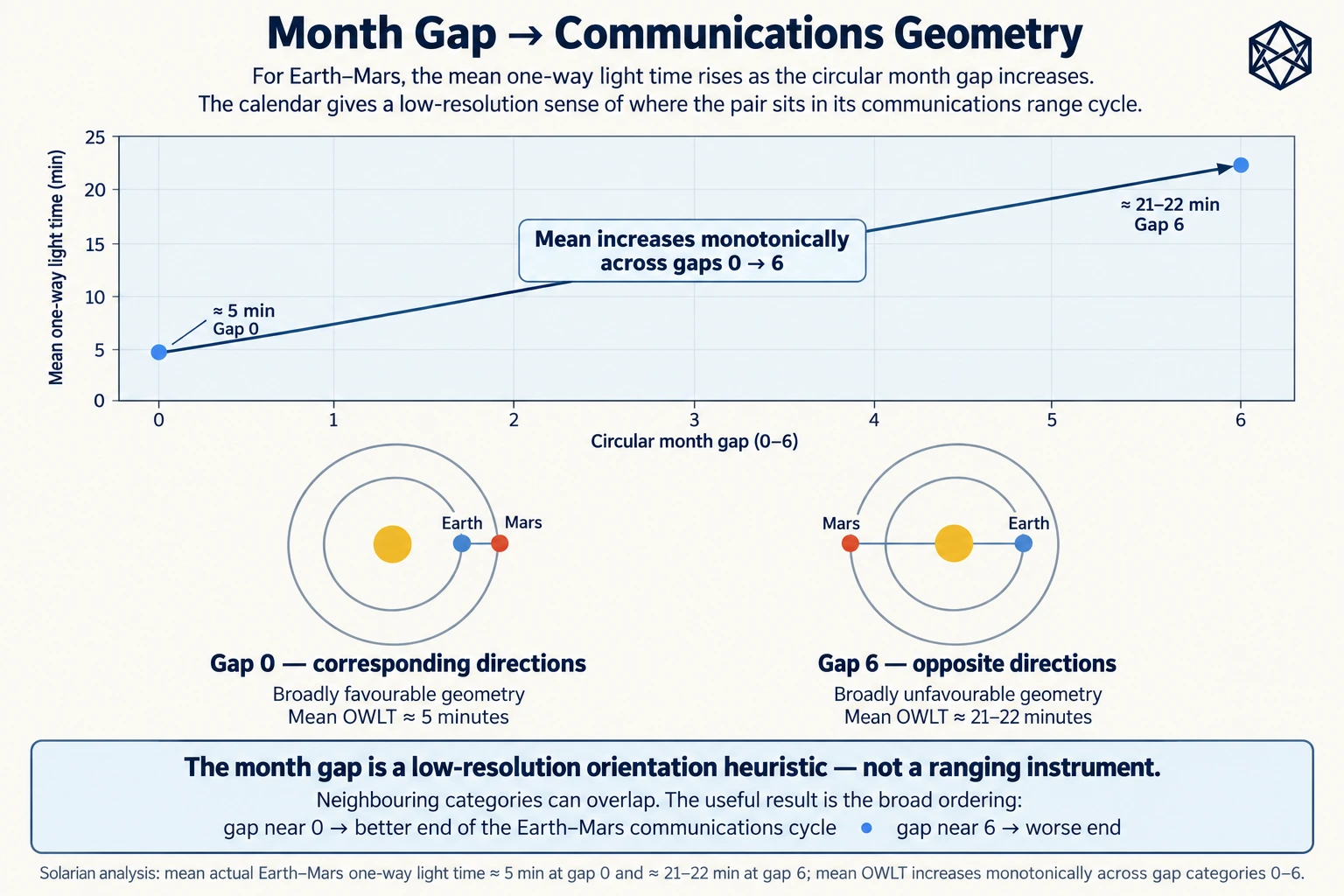
Earth and Mars make the result particularly intuitive.
In the underlying analysis, configurations around month gap zero produced mean one-way light times of roughly:
5 minutes
while configurations around gap six averaged roughly:
21 minutes
Those figures should not become another lookup table people have to memorise.
They demonstrate something more interesting.
Knowing nothing more than the rough month gap moves the expectation from one end of the Earth–Mars communications cycle towards the other.
If the gap is around zero, expect broadly favourable geometry. If it is around six, expect broadly unfavourable geometry.
The exact delay on an individual date may differ substantially from the mean because the real orbits are elliptical and the planets' actual radial distances vary.
But the first-order intuition is right.
An ordinary calendar date has quietly told us something useful about interplanetary geography.
A Solar System with a thousand places
This secondary property becomes much more important once we stop imagining a Solar System containing only a handful of famous planets.
Imagine instead several hundred permanent settlements.
Perhaps eventually there are thousands.
Some sit on planets and moons. Others occupy asteroids, planetary-system habitats, mining settlements and independent artificial worlds.
Every one has precise positional data available.
That does not mean every person carries a useful mental model of all of them.
In fact, the abundance of perfect information makes mental compression more valuable.
Nobody on Earth maintains a database of the precise latitude, longitude, population and travel time of every city they know. People acquire rough geography.
Tokyo is a long way east of London. Paris is close. Australia is far away. New York is several hours behind Britain. Singapore is in roughly this part of the world.
Those statements are laughably imprecise compared with the data available on a telephone.
They are nevertheless enormously useful.
A populated Solar System will need the same kind of cognitive geography.
People will know that Ceres is in the Main Belt. Titan belongs to Saturn. Neptune is an hours-away communications environment.
And, because the orbital calendars share a common twelve-position grammar, they can also know roughly which direction around the Sun those places occupy now.
That final word matters.
Terrestrial geography is largely static.
Solar-System geography moves.
The orbital calendar gives people a lightweight way of carrying part of that movement in their heads.
Where the heuristic becomes unreliable
The fact that this is useful does not make it precise.
Real orbits are not twelve points on circular tracks. They differ in radius, eccentricity, inclination and orientation. Equal-time orbital months do not correspond to perfectly equal heliocentric angles, and the same month gap can therefore contain a range of actual geometries.
Neighbouring categories overlap. A particular configuration at gap two may occasionally produce a greater separation than another configuration at gap three.
That does not erase the broader ordering.
It merely tells us what kind of tool this is.
The month gap is a low-resolution orientation heuristic, not a ranging instrument.
There is an important second limitation.
Month gap measures broad angular geometry, not absolute distance. Earth and Neptune at gap zero remain nowhere near “close”. They are merely towards the favourable end of the enormous Earth–Neptune range.
Destination gives the scale.
Month gap gives the broad position within that scale.
Those two pieces together are enough for the intended mental model.
Eccentricity remains the real boundary
The heuristic also inherits the limitations of the orbital calendar itself.
On low- and moderately eccentric orbits, the standard twelve-month calendar remains a reasonable low-resolution representation of heliocentric position. The Main Belt showed cases where that relationship starts to deteriorate. Pluto showed where the standard representation fails altogether.
A calendar date cannot provide useful orbital intuition if its own month label is no longer a credible indication of where its world sits around the Sun.
So the hierarchy remains clear.
The orbital calendar must first be defensible on its own terms.
Only then does the communications heuristic emerge.
Solarian should never distort an astronomical calendar merely to preserve this secondary property.
The map is a by-product of the calendar.
The calendar is not designed to rescue the map.
Precision remains where it belongs
There is also a bright operational boundary.
No mission controller should calculate a manoeuvre from Janjov. No communications engineer should schedule a critical transmission because a wall calendar says the month gap is two. No navigator should substitute Solarian dates for precise ephemerides.
Spacecraft operations require state vectors, trajectory models, light-time calculations and all the accuracy modern physics and computing can provide.
They will have it.
This chapter is concerned with a different layer of cognition.
Knowing that London lies northwest of Paris does not replace GPS. Knowing that New York is several hours behind London does not replace a world clock. Knowing that Mars is currently towards the opposite side of the heliocentric clock from Earth does not replace an ephemeris.
None of those facts becomes useless because something more precise exists.
Precision and intuition solve different problems.
Why intuition still matters
Software can always tell a resident on Mars the exact current light time to Ceres. It could display every inhabited settlement in a perfect three-dimensional model, updated continuously from high-precision orbital data.
Most people will not spend their lives staring at it.
Humans build background models instead.
We learn relationships and carry them quietly.
In a mature Solar-System civilisation, people may develop an instinct that Jupiter is currently “round that side”, that Mars–Earth communication is getting worse over the next few orbital months, or that Ceres and Saturn are broadly aligned on the same side of the Sun.
A manager dealing with several worlds might glance at their dates and already have a rough feel for which conversations are effectively delayed messaging and which are much slower correspondence. A family with relatives on different planets could possess the same kind of intuition.
Children might learn the twelve-position Solar System clock in school in much the same way children once learned maps and time zones.
Nobody needs to say:
“Our current heliocentric angular separation is approximately 145 degrees.”
They already have the month positions.
The geometry sits quietly underneath them.
A twelve-pixel map
The deeper result is that a common calendar grammar creates a rudimentary common geographical grammar.
Every inhabited world still has its own orbital year. Those years progress at wildly different rates. But their standard twelve orbital positions point towards broadly corresponding directions around one Sun.
The result is something like a twelve-pixel map of the Solar System.
As an astronomical instrument, it is dreadful.
As a human mental model, it may be remarkably good.
For two worlds with validated standard orbital-phase calendars, their civil month positions can suggest whether the worlds are broadly aligned, roughly a quarter orbit apart or near opposite sides of the heliocentric clock. Combined with basic knowledge of the worlds themselves, that gives a rough expectation of distance and communications delay. Specialised astronomical calendars require an explicitly validated phase mapping before that intuition can be transferred to their date labels.
That is a lot of intuition from very little information.
More than a curiosity
The geometry remains an emergent property rather than the reason Solarian exists.
If the month-gap heuristic had no communications value at all, the core architecture would still be needed for human operating cadence, local astronomical calendars and interoperability.
But that should not tempt us to dismiss the effect as merely decorative.
In a civilisation with a handful of settlements, it is interesting. In a civilisation with hundreds or thousands of them, it becomes potentially important.
The precise numbers will always be one query away.
The harder problem is giving human beings an intuitive sense of the moving civilisation they inhabit.
Solarian's common orbital grammar offers one unusually simple piece of that mental infrastructure.
It does not tell us exactly where another world is.
It tells us roughly which way around the Sun to imagine it.
It does not tell us that a message will take 14 minutes and 23 seconds.
It tells us whether, for that destination, we should be thinking towards the better or worse end of the range cycle.
That is deliberately low resolution.
It is also enormously more than nothing.
Civil calendars have always helped people locate themselves within recurring time. In a genuinely inhabited Solar System, a shared astronomical grammar may help them carry a little of its moving geography in their heads as well.
The next chapter turns to the opposite question.
Having established what Solarian can do — including a few things it was never originally designed to do — we should be equally clear about what it cannot.