B - Mathematical Basis & Calendar Selection
Why the Minth, Mear and Repeat Factor Work
Solarian looks more mathematically elaborate than it is.
There are orbital periods measured in thousands of weeks, integer Repeat Factors reaching into the hundreds, minths that occasionally gain or lose a week, and local calendars whose years bear almost no resemblance to Earth's.
Underneath all of that are three very simple facts:
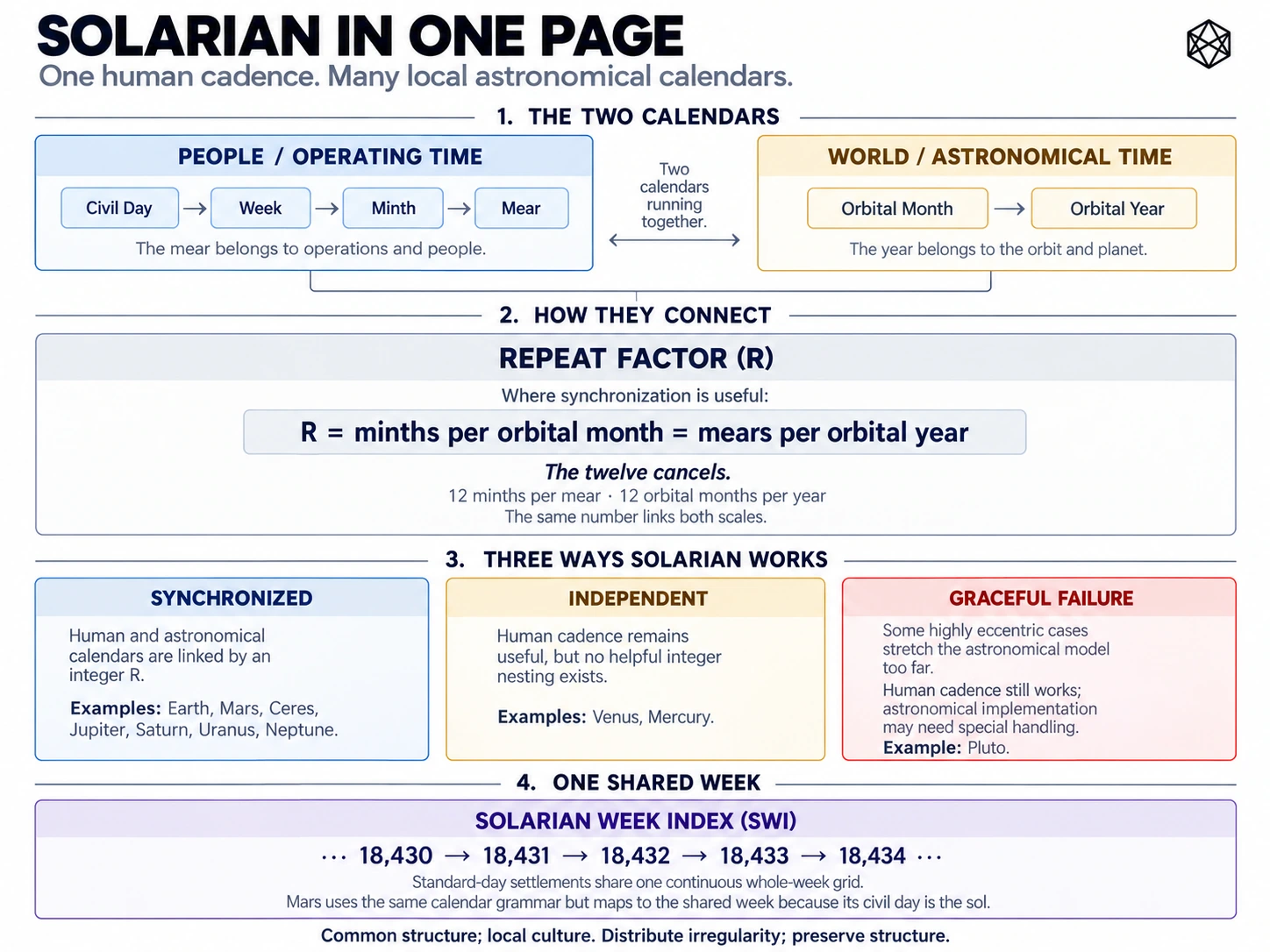
12 minths = 1 mear
12 orbital months = 1 year
and, in a synchronized calendar:
R = mears per year = minths per orbital month
The interesting question is why that works so consistently.
Why should a human operating unit of twelve four-week minths happen to scale from Earth through Mars, the asteroid belt and the outer planets?
Why can almost any sufficiently long planetary year be given a whole-number Repeat Factor?
And why does the system fail in a fairly clean region rather than becoming gradually more complicated as the orbital year changes?
This appendix answers those questions. The mathematics is not difficult.
The slightly surprising part is seeing which mathematics matters.
B.1 Start with the two twelves
The central symmetry of Solarian is easy to overlook because the two sets of twelve describe entirely different things.
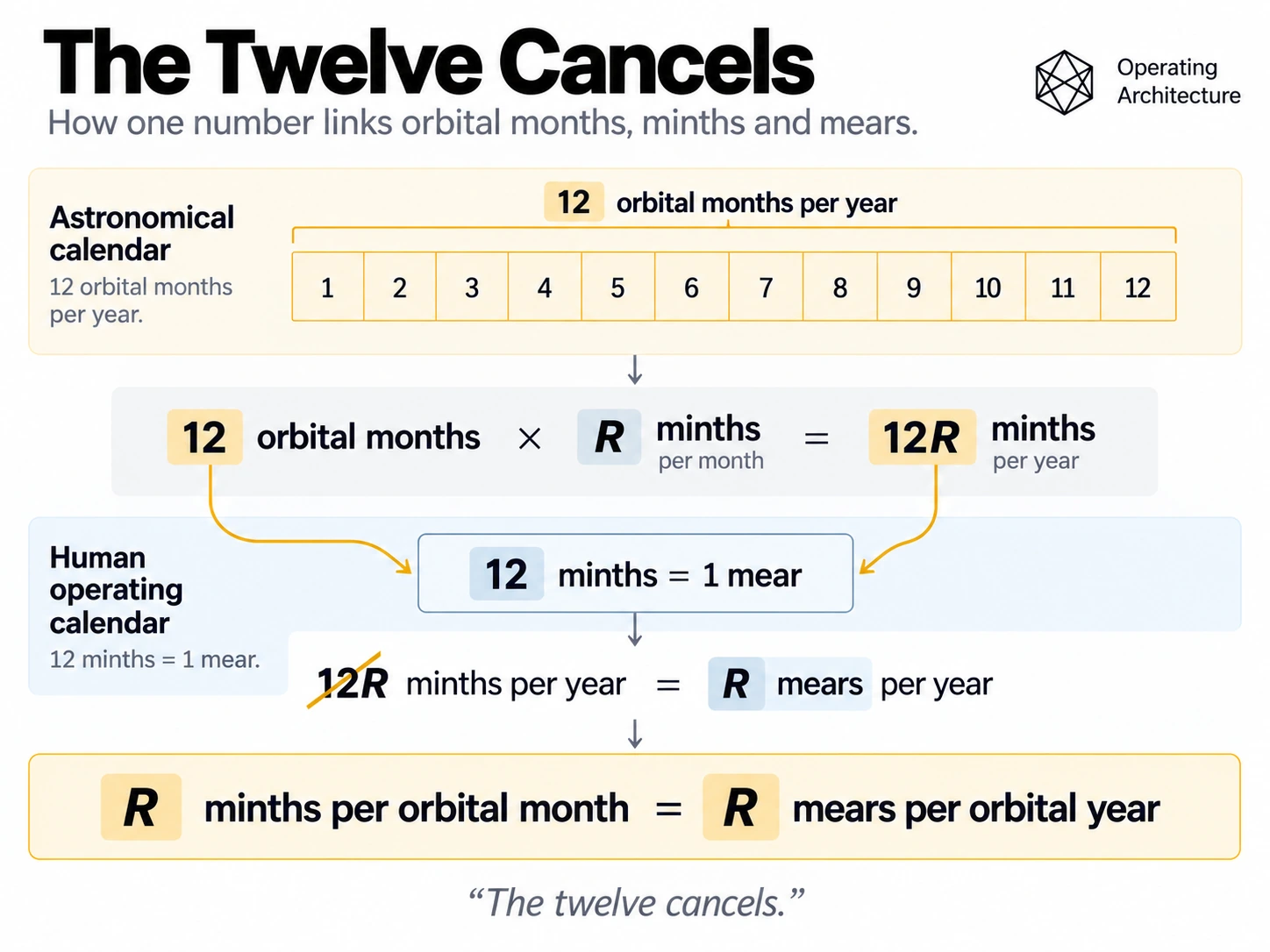
The human calendar contains: 12 minths = 1 mear
The astronomical calendar contains: 12 orbital months = 1 year
Now suppose one orbital year contains R mears.
Each mear contains twelve minths.
So the complete year contains: 12 × R minths
The same year also contains twelve orbital months.
Divide those minths equally across the twelve orbital months: (12 × R) ÷ 12 = R
Each orbital month therefore contains exactly: R minths
So: R = mears per year = minths per orbital month
Nothing else had to be added.
The same argument works in reverse.
If an orbital month contains R minths, then twelve orbital months contain 12 × R minths. Since twelve minths make one mear: (12 × R) ÷ 12 = R mears make the year.
This is why the Repeat Factor works at two scales simultaneously.
The twelve cancels.
That sounds almost trivial once written down.
It was not particularly obvious before it was written down.
B.2 The useful coincidence is designed, not astronomical
There is no deep celestial law saying that the human calendar and the planetary calendar should both contain twelve positions.
The two twelves are a design choice.
But once that choice is made, an important mathematical property follows automatically.
The human hierarchy is: 12 minths → 1 mear
The astronomical hierarchy is: 12 months → 1 year
Because the two ratios share the same number of positions, any whole-number scaling between mear and year automatically becomes the same whole-number scaling between minth and month.
That is the key architectural trick.
Solarian does not require one number describing how many human planning periods fit inside a planetary month and another describing how many human annual cycles fit inside a planetary year.
They are the same number. R13 means: 13 minths per orbital month
And: 13 mears per orbital year
R32 means thirty-two of each.
R179 means 179 of each.
The larger number does not create another level of calendar hierarchy. It simply repeats the human one.
That is the first reason Solarian scales unusually well.
B.3 Where forty-eight comes from
A normal minth contains four weeks. A mear contains twelve minths.
So the nominal mear is: 12 × 4 = 48 weeks
That gives us the basic synchronized year length for any Repeat Factor:
Nominal year length = 48 × R weeks
An R1 calendar therefore has a nominal length of: 48 weeks
R2: 96 weeks
R5: 240 weeks
R13 624 weeks
and R179: 8,592 weeks
The real orbit is unlikely to equal that nominal number exactly. That is not a problem with the Repeat Factor.
It is simply the difference between a clean human structure and untidy physical astronomy.
The expansion joints absorb that remainder.
B.4 The basic calculation
Let Y mean the physical orbital year measured in local civil weeks.
The first estimate of the Repeat Factor is: R ≈ Y ÷ 48
The natural first candidate is normally the nearest whole number: R = nearest whole number to (Y ÷ 48)
This is why the worked examples fall where they do.
| World / system | Approx. year in local weeks | Year ÷ 48 | Natural R |
|---|---|---|---|
| Earth | 52.18 | 1.09 | R1 |
| Mars | 95.51 | 1.99 | R2 |
| R3 habitat | 144.25 | 3.01 | R3 |
| Vesta | 189.4 | 3.95 | R4 |
| Ceres | ~240 | ~5.00 | R5 |
| Jupiter | 618.94 | 12.89 | R13 |
| Saturn | 1,536.53 | 32.01 | R32 |
| Uranus | 4,383.63 | 91.33 | R91 |
| Neptune | 8,598.43 | 179.13 | R179 |
Nothing special happened at Neptune. Its very large R is simply its orbital period divided by the same forty-eight-week human scale. The calendar has grown by repetition.
B.5 The surprisingly important number 24
Rounding to the nearest integer gives us a useful guarantee.
Adjacent nominal Repeat Factors are forty-eight weeks apart.
For example: R5 = 240 weeks
And: R6 = 288 weeks
The midpoint is: 264 weeks
That midpoint is twenty-four weeks away from either nominal structure.
This is true for every pair of adjacent Repeat Factors.
So when we choose the nearest integer R, the nominal synchronized year can never be more than: 24 weeks away from the target orbital year.
In shorthand: Maximum mismatch from the nearest R family = 24 weeks
That twenty-four-week limit is the key to the whole coverage result.
At first glance, twenty-four weeks sounds like a lot. The next observation changes that.
B.6 Every minth contains one week of controlled flexibility
A normal synchronized minth contains four weeks.
A designated minth can instead contain three or five.
So each adjusted minth can change the civil year by: minus 1 week
Or: plus 1 week
An R calendar contains: 12 × R minths
So its absolute theoretical adjustment capacity is: plus or minus 12 × R weeks
if every minth were adjusted.
Solarian would not normally want to do anything remotely that extreme.
The important point is that, for an existence proof, we do not need to.
The nearest Repeat Factor is never more than twenty-four weeks from the target.
So the question becomes: Does the calendar contain at least twenty-four minths capable of absorbing twenty-four one-week adjustments?
For R2 or greater, yes.
R2 contains: 12 × 2 = 24 minths
R3 contains 36. R5 contains 60. R179 contains 2,148.
That gives us the central mathematical result.
B.7 The synchronized coverage result
For every orbital year sufficiently long to select R2 or greater, a whole-number Repeat Factor is always structurally available.
The reasoning is only three steps:
Adjacent nominal R values are forty-eight weeks apart.
The nearest one is therefore no more than twenty-four weeks away.
An R2-or-greater calendar contains at least twenty-four minths, each capable of absorbing one week of correction.
Therefore: Any orbital year of 72 weeks or more has an integer synchronized Solarian construction.
Why seventy-two?
Because the nominal R2 year is: 96 weeks
and the lower midpoint boundary is: 96 − 24 = 72 weeks
The preferred mathematical regions therefore become:
| Repeat Factor | Preferred orbital-year region |
|---|---|
| R2 | 72–120 weeks |
| R3 | 120–168 weeks |
| R4 | 168–216 weeks |
| R5 | 216–264 weeks |
| R6 | 264–312 weeks |
| R7 | 312–360 weeks |
and so on.
In general: R family range = 48R − 24 through 48R + 24 weeks for R2 and above.
The upper boundary of one family is exactly the lower boundary of the next.
For example: R4 ends at 216 weeks
And: R5 begins at 216 weeks.
So the ranges touch. There are no gaps. That is the important result.
B.8 The picture is simpler than the algebra
The family structure can be thought of as a number line.
R2 >> 72 —— 96 —— 120
R3 >> 120 —— 144 —— 168
R4 >> 168 —— 192 —— 216
R5 >> 216 —— 240 —— 264
The middle number is the untouched 48R-week calendar.
Moving left requires week contractions. Moving right requires week expansions.
At the exact midpoint between two families, either R is equally close mathematically.
Beyond that point, the next R becomes the cleaner construction.
This is why the asteroid belt falls naturally into R4, R5, R6 and R7 families rather than requiring nineteen bespoke calendar architectures.
Their orbital periods form a continuum. The integer Repeat Factors form a lattice laid across it.
B.9 R1 is the special boundary case
R1 behaves differently.
An R1 year contains only: 12 minths
So its maximum standard synchronized adjustment is twelve weeks rather than twenty-four.
Starting from its nominal forty-eight-week mear: 48 − 12 = 36 weeks
And: 48 + 12 = 60 weeks
Therefore the full R1 structural range is: 36–60 weeks
This creates the only deliberate gaps in the arithmetic coverage.
The complete picture is:
| Orbital-year length | Standard arithmetic result |
|---|---|
| Below 36 weeks | No synchronized R |
| 36–60 weeks | R1 available |
| More than 60 but less than 72 weeks | No synchronized R |
| 72 weeks and above | Integer synchronized R always available |
This is a more interesting result than merely saying: divide the orbital year by forty-eight.
There are two short-year regions in which the architecture correctly says: Do not synchronize these clocks.
B.10 Venus and Mercury are not awkward exceptions
Venus has an orbital year of about: 32.10 weeks
That falls below the minimum synchronized R1 year: 36 weeks
Even if all twelve R1 minths were contracted from four weeks to three: 12 × 3 = 36 weeks the calendar would still be longer than the Venusian orbit.
There is therefore no integer synchronized solution under the standard minth rules.
Mercury is more extreme at only: 12.57 weeks
The independent regime is not a patch added after the mathematics failed. It is the mathematically correct regime for these orbital scales.
A hypothetical world with a 66-week year would produce the other short-year problem. R1 cannot stretch beyond sixty weeks. R2 cannot contract below seventy-two. So sixty-six weeks falls into the deliberate 60–72-week gap.
Again, the answer is not R1.375.
The answer is that the human and astronomical calendars should not be nested.
B.11 Why the long outer planets are mathematically easier
This is one of the least intuitive properties of Solarian.
We tend to assume Neptune should be a more difficult calendar problem than Earth because its year is enormous.
Mathematically, the opposite is largely true. The worst possible error caused by choosing the nearest R remains: 24 weeks whether the world is R2 or R179.
But the total year becomes larger and larger. So the correction becomes a smaller fraction of the whole calendar.
The worst-case relative mismatch is: 24 ÷ (48 × R)
which simplifies to: 1 ÷ (2 × R)
So:
| R | Maximum relative mismatch |
|---|---|
| R2 | 25% |
| R13 | 3.85% |
| R32 | 1.56% |
| R179 | 0.28% |
The actual worked examples are usually much better than these worst cases.
The important principle is the direction of travel: The longer the orbital year, the smaller the structural correction becomes relative to the calendar as a whole.
The giant planets look intimidating because their year numbers are large. Their scale actually makes the integer architecture easier to preserve.
B.12 The same result appears as adjustment density
There is another way to see this.
Suppose a chosen whole-week civil year contains N weeks.
The nominal R calendar contains: 48 × R weeks
The required correction is therefore: Correction = N − (48 × R)
If the answer is: +5 the calendar needs five one-week expansions.
If it is: −6 the calendar needs six one-week contractions.
Because each adjustment changes one minth by one week, the minimum number of adjusted minths is simply the absolute size of that correction.
The year contains: 12 × R minths
So the proportion of minths needing adjustment is: number of adjusted weeks ÷ total minths
Since the nearest R is never more than twenty-four weeks away, the theoretical worst-case adjustment density is: 24 ÷ (12 × R)
Or: 2 ÷ R
For R13, no more than roughly 15 per cent of minths need adjustment even at the theoretical edge of the preferred family.
For R32, the worst case is about 6 per cent. For R179, barely 1 per cent.
Again, the real examples are often considerably cleaner. Saturn requires almost nothing. Neptune's enormous year is structurally less troublesome than many asteroids.
This is another reason the architecture scales outward rather than becoming progressively more complicated.
B.13 Mathematical possibility is not the same as elegance
The coverage result needs an important qualification.
It proves that an integer synchronized structure can be built. It does not prove that every such structure is attractive.
Consider a year close to the edge of an R family. It may require many minths to be adjusted.
The construction is valid, but it may be less elegant than one close to the nominal: 48 × R weeks.
This gives us a useful distinction. Possible means the arithmetic can preserve the protocol. Good means it does so with limited irregularity and useful astronomical behaviour.
Those are not the same test.
The Main Belt contains examples of both.
Ceres sits almost exactly on the R5 nominal centre: 5 × 48 = 240 weeks Very little correction is required.
Psyche is also R5, but its roughly 261-week orbit lies close to the upper edge of the preferred R5 region. The same skeleton still works. It simply requires considerably more use of the expansion-joint mechanism.
That is not a failure of integer R It is a less elegant member of the same family.
B.14 The nearest R minimises the correction
The nearest-integer rule has another simple justification.
For any candidate R, the nominal synchronized year is: 48 × R weeks
The amount of adjustment required is the difference between that number and the actual whole-week civil year.
Choosing the nearest multiple of forty-eight therefore normally minimises the correction. And because each week of correction requires one adjusted minth, it also normally minimises the number of adjusted minths.
A different R can sometimes still be mathematically possible. But the more distant R will normally require much more calendar movement.
At an exact family boundary, such as 120 weeks, R2 and R3 are equally distant.
R2 nominal: 96 weeks
Difference: 120 − 96 = 24 weeks
R3 nominal: 144 weeks
Difference: 144 − 120 = 24 weeks
The arithmetic alone cannot choose.
Other criteria then matter: distribution quality, orbital-month behaviour, phase fidelity and implementation simplicity.
That is why Appendix A describes the nearest integer as the first candidate, not an automatic answer.
B.15 Why only two civil year lengths are required
The physical orbital year is almost never an exact whole number of weeks.
Suppose a physical year is: 1536.53 weeks
as Saturn approximately is. A whole-week calendar cannot contain 0.53 of a week.
But it does not need to.
Use the two adjacent whole-week values: 1,536 weeks
And: 1,537 weeks
If 1,537-week years are used about 53 per cent of the time, and 1,536-week years about 47 per cent of the time, the long-run average approaches: 1,536.53 weeks
More generally, suppose an orbital year is: N whole weeks + some fraction
If the fraction is 0.25, use the longer form roughly one quarter of the time. If the fraction is 0.75, use it roughly three quarters of the time.
Any fractional physical year can therefore be represented over time using only the two adjacent whole-week year lengths.
No third year length is mathematically necessary.
That is why each standard implementation needs only: one Common form
And: one Leap form
B.16 Common and Leap fall out of parity
Adjacent whole numbers always have opposite parity.
One is even. The other is odd.
Solarian therefore calls: even-week form = Common Year
And: odd-week form = Leap Year
This immediately explains why Leap cannot mean longer year. Sometimes the odd number is above the physical average. Sometimes it is below.
Mars makes this particularly clear. Its physical year is approximately: 95.51 weeks The two adjacent whole-week civil forms are: 95 weeks And: 96 weeks Ninety-five is odd. So it is the Leap Year. Ninety-six is even.
So it is the Common Year. The Leap Year is therefore shorter.
Nothing has gone wrong. Parity is doing exactly what the protocol says.
B.17 The fractional part tells us the long-run balance
The same arithmetic also tells us roughly how frequently the two year forms are required.
Suppose the orbital year is: N + 0.53 weeks
Then the longer form should appear about: 53% f the time.
The shorter form should appear about: 47% of the time.
Saturn is approximately: 1,536.53 weeks So its 1,537-week form should occur about 53 per cent of the time. Since 1,537 is odd, that is the Leap form.
Jupiter is approximately: 618.94 weeks So its 619-week form dominates, at roughly 94 per cent in the simple mean-period model.
Mars is approximately: 95.51 weeks so its 95- and 96-week forms occur in nearly equal proportions.
This tells us the required long-run balance. it does not tell us the exact deterministic sequence.
B.18 Why Common and Leap remain almost identical
At a fixed Repeat Factor, the two adjacent civil year forms differ by only one week.
That means their internal structures can also normally differ by only one expansion or contraction.
Saturn
Nominal R32 year: 32 × 48 = 1,536 weeks Common Year: 1,536 weeks Correction: 0
Leap Year: 1,537 weeks Correction: +1 Only one expansion changes.
Mars
Nominal R2 year: 2 × 48 = 96 weeks Common Year: 96 weeks Correction: 0
Leap Year: 95 weeks Correction: −1 Only one contraction changes.
Earth
Nominal R1 year: 48 weeks Common Year: 52 weeks Correction: +4
Leap Year: 53 weeks Correction: +5
Again the two forms differ by only one additional expansion. This is why the protocol can absorb astronomical irregularity without producing many different calendar forms.
B.19 A second hidden pattern: when months and mears line up
There is another useful mathematical pattern inside R.
A mear contains: 12 minths
An orbital month contains: R minths
So the frequency with which mear boundaries and orbital-month boundaries coincide depends on whether R shares factors with twelve.
The technical tool for this is called the greatest common divisor, or GCD.
It simply means: the largest whole number that divides both values.
Mars — R2
Twelve and two share a greatest common divisor of: 2
The two calendars therefore meet at a mear boundary every: 12 ÷ 2 = 6 orbital months
That is why one Martian mear spans Months 1–6 and the next spans Months 7–12.
R3 habitat
Twelve and three share a greatest common divisor of: 3
So the structures meet every: 12 ÷ 3 = 4 orbital months
That is why each R3 mear contains exactly four complete orbital months.
Jupiter — R13
Twelve and thirteen share no factor except one.
So their greatest common divisor is: 1
The two boundary systems do not fully line up again until: 12 ÷ 1 = 12 orbital months
In other words: the end of the whole year
That is why the starting minth letter appears to move through successive Jovian months before the complete pattern returns at New Year.
This is not another protocol rule. It is simply something the integer R creates automatically.
B.20 Why some R values feel tidier than others
This also explains why two calendars with equally good orbital fits may feel structurally different.
If R shares useful factors with twelve, month and mear boundaries line up relatively often.
Examples include: R2, R3, R4, R6, R12, R24
If R and twelve share no factor other than one, the two cycles weave through one another and fully realign only at the end of the year.
Examples include: R5, R7, R13, R91, R179
Neither is mathematically better. One produces more repeated internal blocks. The other produces a more interlaced pattern.
This is worth understanding because calendar elegance is not represented by R alone. R tells us the scale relationship. Its factors tell us something about the internal rhythm.
B.21 The mathematics does not prove orbital-month accuracy
The strongest limitation of this appendix is important.
Everything so far concerns calendar arithmetic. It tells us whether:
a whole-number R exists;
human structures can fit inside the year;
week corrections can be absorbed; and
month/minth counts remain internally coherent.
It does not prove that the twelve orbital months remain good approximations of heliocentric position. That is a separate astronomical question.
A highly eccentric orbit can pass the arithmetic test perfectly and still fail the phase-fidelity test.
Pluto is the clearest example. Its candidate R270 structure is arithmetically straightforward. The problem is not fitting minths and mears inside its year. The problem is that twelve broadly equal-time months cease to provide a sufficiently good twelve-position representation of its highly eccentric orbit.
So: Integer R is necessary for a synchronized implementation.
It is not sufficient.
B.22 Mathematical possibility does not prove usability
There is another limitation.
A calendar near the edge of an R range may be structurally valid while requiring many three- or five-week minths.
That may satisfy the protocol. It may not be a particularly pleasant calendar.
The mathematics can tell us: This construction exists.
It cannot tell us: People will enjoy using it.
Adjustment density is therefore useful as a design indicator.
A lower density generally means the human calendar stays closer to its nominal four-week rhythm.
But there is no mathematical theorem telling us the exact percentage at which humans begin to dislike a calendar.
That is a human-factors question. Solarian deliberately separates mathematical validity from adoption.
B.23 The synchronized threshold is architectural, not physical
The boundaries at 36, 60 and 72 weeks should also be understood correctly.
Nothing physical suddenly happens to a planet when its year changes from 35 weeks to 36.
These boundaries arise from the Solarian design choices:
twelve minths per mear;
four weeks per normal minth;
three to five weeks as the permitted synchronized minth range; and
integer Repeat Factors only.
Change those design choices and the boundaries move. Solarian keeps them because the objective is not to maximise mathematical coverage at any cost.
It is to preserve a useful human cadence. A two-week minth would allow synchronization farther inward. It would also stop behaving like the human-scale period the minth was created to provide.
The independent regime means we do not need to damage the human unit simply to win an arithmetic argument.
B.24 Why the model is not mathematically intuitive
In retrospect, the Repeat Factor can feel obvious.
That is deceptive.
The usual way to think about another world's calendar is to begin with the orbit. Take the planetary year. Divide it by twelve. Call the results months. Then somehow divide those months into units useful for humans.
That approach puts the astronomy first and asks people to fit inside it.
Solarian starts differently. It creates two independent hierarchies.
One is human: week → minth → mear
The other is astronomical: month → year
The non-obvious step is noticing that both hierarchies can contain twelve positions. Once they do, the algebra collapses. The same integer appears at both scales.
That is the intellectual leap. Not a difficult calculation. A different way of arranging the problem.
B.25 Earth makes the pattern harder to see
Earth does not help us discover this structure.
It hides it.
On Earth: R1 So: 1 mear ≈ 1 year And: 1 minth ≈ 1 month
The two hierarchies lie almost on top of one another. There is little reason, from Earth alone, to imagine that they are different things.
Jupiter makes the distinction obvious. Neptune makes it impossible to ignore. Venus proves that the two can separate altogether.
The mathematics looks more natural once Earth stops being treated as the general case.
B.26 Big numbers also disguise a simple structure
There is another psychological obstacle.
Numbers such as R91 or R179 look complicated.
They are not.
R179 contains no more mathematical ideas than R2. It means: 179 mears per year And: 179 minths per orbital month
That is all.
The number is large because Neptune's orbit is long. The protocol has not become more complicated. In fact, as we saw earlier, the relative correction problem has become easier.
This is a useful general lesson in system design. Large scale does not necessarily require more kinds of structure. Sometimes it requires more repetitions of the same structure.
B.27 The mathematical architecture in four lines
Most of this appendix can be reduced to four statements.
1. Human and astronomical symmetry
12 minths = 1 mear
12 orbital months = 1 year
Therefore: R = mears per year = minths per orbital month
2. Nominal synchronized year
Nominal year = 48 × R weeks
3. Required whole-week correction
Correction = actual civil-year weeks − (48 × R)
4. Nearest-family limit
For R2 and above: the nearest nominal R structure is never more than 24 weeks away
Almost everything else is implementation.
B.28 The core result
The useful mathematical conclusion is not that every possible orbit has a synchronized Solarian calendar.
It does not.
The stronger and more precise result is:
R1 provides synchronized coverage from 36 to 60 weeks.
Between 60 and 72 weeks, no standard synchronized integer R exists.
From 72 weeks upward, a whole-number synchronized Repeat Factor is always arithmetically available.
That availability follows from the architecture itself.
It is not a lucky pattern discovered among the planets we happened to test. The Solar System happens to provide examples across many of those integer families. But the result would remain true even if the planets were somewhere else.
That is why the minth–mear structure is more than a collection of individually fitted calendars. It is a general mathematical architecture.
And, like several useful mathematical ideas, its main trick looks almost embarrassingly simple after somebody points it out.
Twelve human periods. Twelve astronomical periods. A forty-eight-week human cycle. One integer between them.
The rest is a remainder.