EARTH
18) The Calendar We Already Invented
Earth and the R1 Thought Experiment
Earth came last.
That matters.
Solarian was not designed by taking the Gregorian calendar and asking how it might be extended across the Solar System. The architecture emerged from places where familiar terrestrial assumptions stop working: Mars, the giant planets and their moons, the asteroid belt, artificial worlds and eventually Pluto.
Only after that structure was substantially developed does the obvious question become interesting:
What happens if we point Solarian back at Earth?
Forget, for a moment, the Gregorian calendar, Roman months, religious conventions, inherited names and several thousand years of accumulated cultural history. Imagine instead that humans arrive at an uninhabited blue-green third planet from the Sun with the Solarian protocol already in hand.
We know the astronomy. We use the standard 86,400-second civil day, which conveniently coincides with Earth's natural solar day.
What calendar does the protocol produce?
The answer is one of the more satisfying results in the book.
It gives us:
R1
And from that single number falls a calendar remarkably similar to one humans have already reinvented whenever they have wanted Earth time to behave more cleanly for operations.
Earth at a glance
| Mean distance from Sun | 149.6 million km / 1.00 AU |
|---|---|
| Sidereal orbital period | 365.256 days |
| Orbital period | 52.179 standard weeks |
| Orbital eccentricity | 0.0167 |
| Axial tilt | 23.44° |
| Natural solar day | 24 h / 86,400 seconds |
| Surface gravity | 1.00 g |
| Natural satellite | Moon |
Earth is about as accommodating as a natural world can be for the human side of Solarian.
Its natural day and the standard civil day coincide. The seven-day week is already deeply embedded in human practice, while Earth's low orbital eccentricity means twelve broad civil divisions remain a perfectly adequate approximation of progress around the Sun.
The interesting part is the length of the year.
Earth's Solarian Calendar
| Solarian element | Earth implementation |
|---|---|
| Civil day | 86,400 standard seconds — the natural Earth solar day |
| Week | 7 standard days |
| Repeat Factor | R1 |
| Orbital months | 12 — Jan to Dec reference notation |
| Operating mears per orbital year | 1 |
| Minths per orbital month | 1 |
| Minths per orbital year | 12 |
| Mean physical orbital year | 365.256 days / 52.179 weeks |
| Common Year | 52 weeks = 364 days = 12 minths = 12 months |
| Leap Year | 53 weeks = 371 days = 12 minths = 12 months |
| Long-run year balance | about 82% Common : 18% Leap — approximately one Leap Year every 5–6 years in the Solarian protocol calendar |
| Nominal unadjusted year | 48 weeks (1 × 48) |
| Common Year minth pattern | (8 × 4-week minths) + (4 × 5-week minths) = 52 weeks The mear-terminal Minth L expands first; three secondary expansion joints are distributed evenly through the mear. A · B · C · D · E · F · G · H · I · J · K · L 4 · 4 · 5 · 4 · 4 · 5 · 4 · 4 · 5 · 4 · 4 · 5 = 52 weeks One complete 52-week mear |
| Leap Year minth pattern | (7 × 4-week minths) + (5 × 5-week minths) = 53 weeks The Common Year pattern is retained and one additional secondary expansion week is added late in the mear. 4 · 4 · 5 · 4 · 4 · 5 · 4 · 4 · 5 · 4 · 5 · 5 = 53 weeks One complete 53-week mear |
| Common Year month pattern | 4 · 4 · 5 · 4 · 4 · 5 · 4 · 4 · 5 · 4 · 4 · 5 weeks Equivalent to four 13-week quarters, each arranged 4 · 4 · 5 |
| Leap Year month pattern | 4 · 4 · 5 · 4 · 4 · 5 · 4 · 4 · 5 · 4 · 5 · 5 weeks Equivalent to three 13-week quarters and one 14-week quarter |
| Year structure | 1 complete operating mear = 1 orbital year |
In one line:
Earth is R1 — one minth per orbital month and one operating mear per Earth year.
Why R1?
Earth's orbit lasts about:
52.18 weeks
The nominal human mear contains:
48 weeks
So:
52.18 ÷ 48 ≈ 1.09
The synchronized Solarian relationship is therefore:
R1
That means:
1 operating mear = 1 Earth orbital year
and:
1 minth = 1 Earth orbital month
Earth is the only major worked example in the book where the two Solarian calendars nearly sit on top of one another.
That explains rather a lot.
R1 hides the two calendars
Solarian has spent much of this book insisting on a distinction that becomes obvious at Saturn, Uranus or Neptune:
The mear belongs to operations and people.
The year belongs to the orbit and planet.
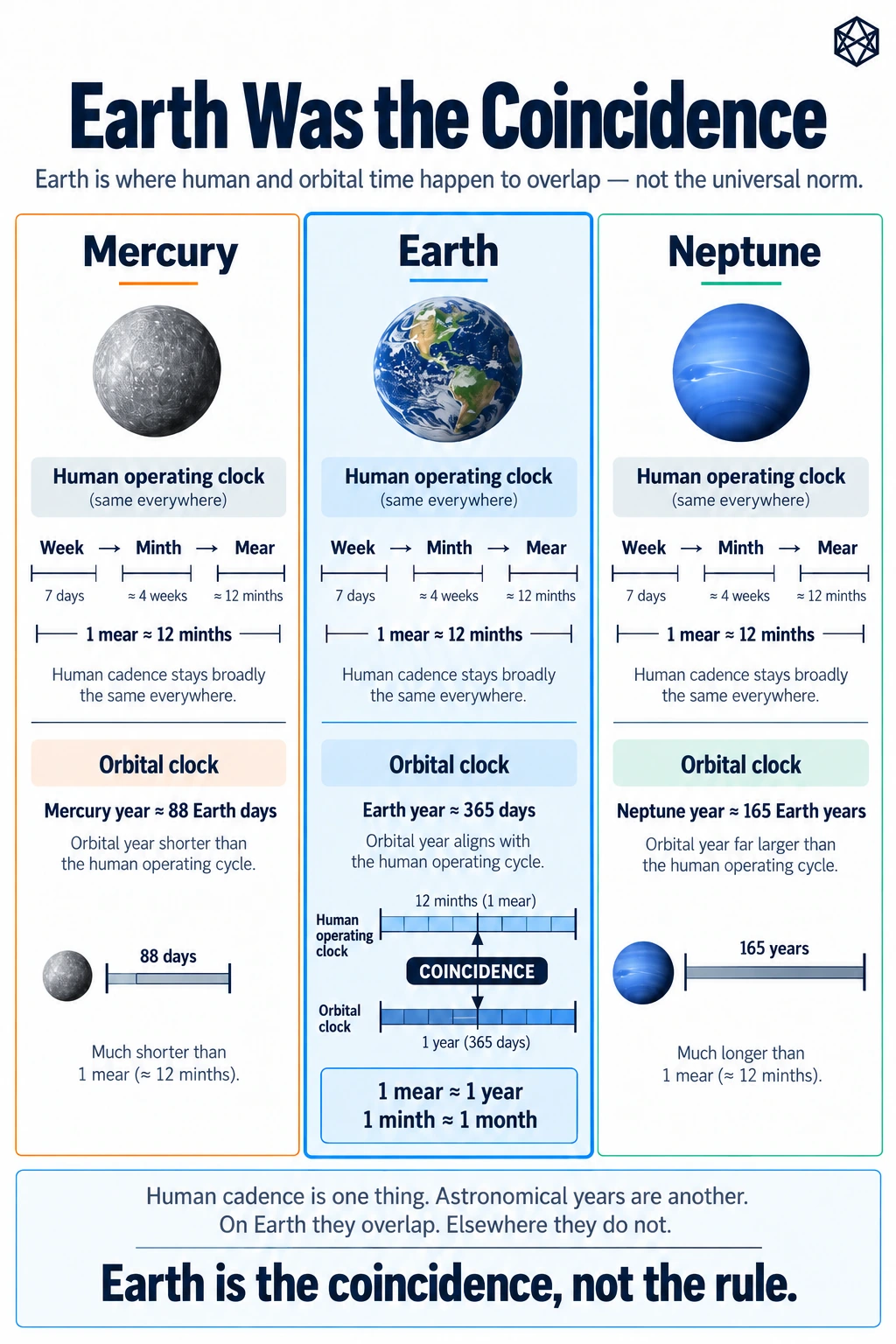
Earth conceals that distinction because R = 1. There is one human operating mear inside one astronomical year and one minth inside each orbital month.
So, from the perspective of an Earthbound civilisation:
mear ≈ year
and:
minth ≈ month
If Earth were the only world humans expected ever to inhabit, there would be little practical reason to invent different names for those concepts. For almost all of human history, that was exactly our position.
The useful human annual cycle and the physical astronomical year happen to exist at approximately the same scale, so one calendar hierarchy has been asked to perform both jobs.
That arrangement feels natural because, on Earth, it largely is.
The hidden assumption only becomes visible when we export it.
Mars has a year almost twice as long. Jupiter takes nearly twelve Earth years to orbit the Sun. Neptune takes 165. At that point, asking the astronomical year to continue serving as the main recurring human planning cycle becomes increasingly implausible.
Solarian emerged by separating two ideas that Earth had allowed us to mistake for one.
Earth is therefore not an exception to the theory.
It is the place where the distinction is hardest to see.
The nominal 48-week mear is too short
R1 also creates an interesting intercalation problem.
The nominal Solarian mear contains twelve ordinary four-week minths:
12 × 4 = 48 weeks
But Earth's physical year lasts a little more than 52 weeks. The operating calendar therefore needs roughly four additional weeks in an ordinary civil year.
The primary expansion joint — terminal Minth L — can provide one of them by expanding from four weeks to five. Three more are still required.
So Earth is a straightforward example of the secondary expansion-joint mechanism introduced earlier. Rather than concentrating all of the correction at the end of the year, additional five-week minths are distributed through the mear.
For the 52-week Common Year, the resulting pattern is:
4 · 4 · 5 | 4 · 4 · 5 | 4 · 4 · 5 | 4 · 4 · 5
Minths C, F, I and L contain five weeks. The other eight contain four.
And immediately something rather familiar appears.
Four 13-week quarters
The Common Year divides naturally into four identical operating quarters:
4 weeks + 4 weeks + 5 weeks = 13 weeks
Four times:
13 × 4 = 52 weeks
The quarter is not a fundamental Solarian unit. Nothing in the protocol requires a society to use quarters at all. On Earth, however, R1 makes them an exceptionally convenient derived grouping.
| Derived quarter | Minths | Weeks |
|---|---|---|
| Q1 | A · B · C | 4 · 4 · 5 = 13 |
| Q2 | D · E · F | 4 · 4 · 5 = 13 |
| Q3 | G · H · I | 4 · 4 · 5 = 13 |
| Q4 | J · K · L | 4 · 4 · 5 = 13 |
| Common Year | A–L | 52 weeks |
Every quarter contains exactly thirteen complete weeks. Equivalent minths contain the same number of weekdays and weekends. Every minth begins on the first weekday and ends on the seventh.
The calendar no longer needs a mixture of 30- and 31-day months or month boundaries that migrate through the weekday cycle. The cost is that some minths contain twenty-eight days and others thirty-five.
From an operating perspective, that is a remarkably clean trade.
The 53-week Leap Year
A 52-week civil year contains only 364 days. Earth's physical orbit lasts a little more than 365¼ days, so the calendar must periodically recover the accumulated difference.
Solarian does this in the same way it corrects every other synchronized implementation:
with a whole week.
Approximately once every five or six years, Earth therefore uses a 53-week Leap Year rather than a 52-week Common Year.
The Common Year already has four five-week minths, including terminal Minth L. Rather than creating a six-week minth, the additional week goes to another secondary expansion joint late in the mear:
4 · 4 · 5 | 4 · 4 · 5 | 4 · 4 · 5 | 4 · 5 · 5
The first three quarters remain thirteen weeks. The fourth becomes fourteen.
That is essentially the entire complication.
A formal implementation would specify the exact deterministic long-run leap-week rule in the protocol tables. For ordinary users, the visible result is simply an occasional 53rd week.
And what about the Moon?
Earth has one obvious companion that deserves explicit treatment.
A permanent lunar settlement would possess many important local cycles of its own. Illumination, surface operations, communications geometry and transport between Earth and the Moon would all depend on the Moon's motion.
But the Moon does not need a separate heliocentric civil year.
At the scale relevant to the Solarian astronomical calendar, Earth and the Moon travel around the Sun together. A lunar settlement therefore naturally inherits the Earth-system orbital year in exactly the same way that Ganymede inherits Jupiter's or Titan inherits Saturn's.
The human operating layer is equally straightforward. A lunar settlement can use the standard 86,400-second civil day, seven-day week, minths and mears, sharing the Solarian Week directly with other standard-day settlements. The very long local light-dark cycle remains useful environmental and operational information without needing to redefine the civil day.
So the Moon does not require a special Solarian calendar.
It needs an Earth-system calendar plus local lunar coordinates for the cycles that actually matter locally.
That is consistent with the architecture used everywhere else:
shared heliocentric journey → shared astronomical year
local environmental cycle → local operational information
The Moon is therefore less a special case than a useful confirmation that the planetary-system rule applies close to home as well as around Jupiter or Saturn.
The calendar we already reinvented
The Earth thought experiment should not be confused with a claim about how the Gregorian calendar actually developed. It did not emerge from a blank-sheet engineering exercise. It is the result of centuries of astronomy, religion, politics, agriculture, institutional inheritance and previous calendars.
Gregorian is exceptionally successful at the job history gave it, particularly keeping the civil calendar aligned with the seasonal year.
Solarian asks a different question.
Suppose we inherited none of that calendar history and instead began with these requirements:
preserve an uninterrupted seven-day week;
construct larger civil units from whole weeks;
retain twelve human-scale operating periods;
retain twelve broad astronomical periods;
place major boundaries on week boundaries; and
keep the operating and orbital calendars synchronized using whole-week correction.
What would Earth look like?
The answer is not Gregorian.
It is essentially the R1 calendar above.
And humans have, in a narrower operational context, already discovered something remarkably similar.
When organisations care more about comparing equivalent operating periods than preserving historical month lengths, 4-4-5-type fiscal calendars divide the year into twelve week-based periods grouped into four thirteen-week quarters.
The exact variants differ. Some use 4-5-4 or 5-4-4 rather than 4-4-5. Starting weekdays vary. The treatment of the occasional 53rd week differs.
But the structural idea is strikingly similar:
12 operating periods
4 × 13-week quarters
52-week ordinary year
occasional 53-week adjustment
stable week-based boundaries
That resemblance matters more than the precise implementation.
Humans have already discovered that when the purpose of the calendar is operational consistency rather than inherited civil convention, a 52/53-week structure built from four- and five-week periods is exceptionally practical.
Solarian reaches almost the same architecture from an entirely different direction.
The accidental Earth optimum
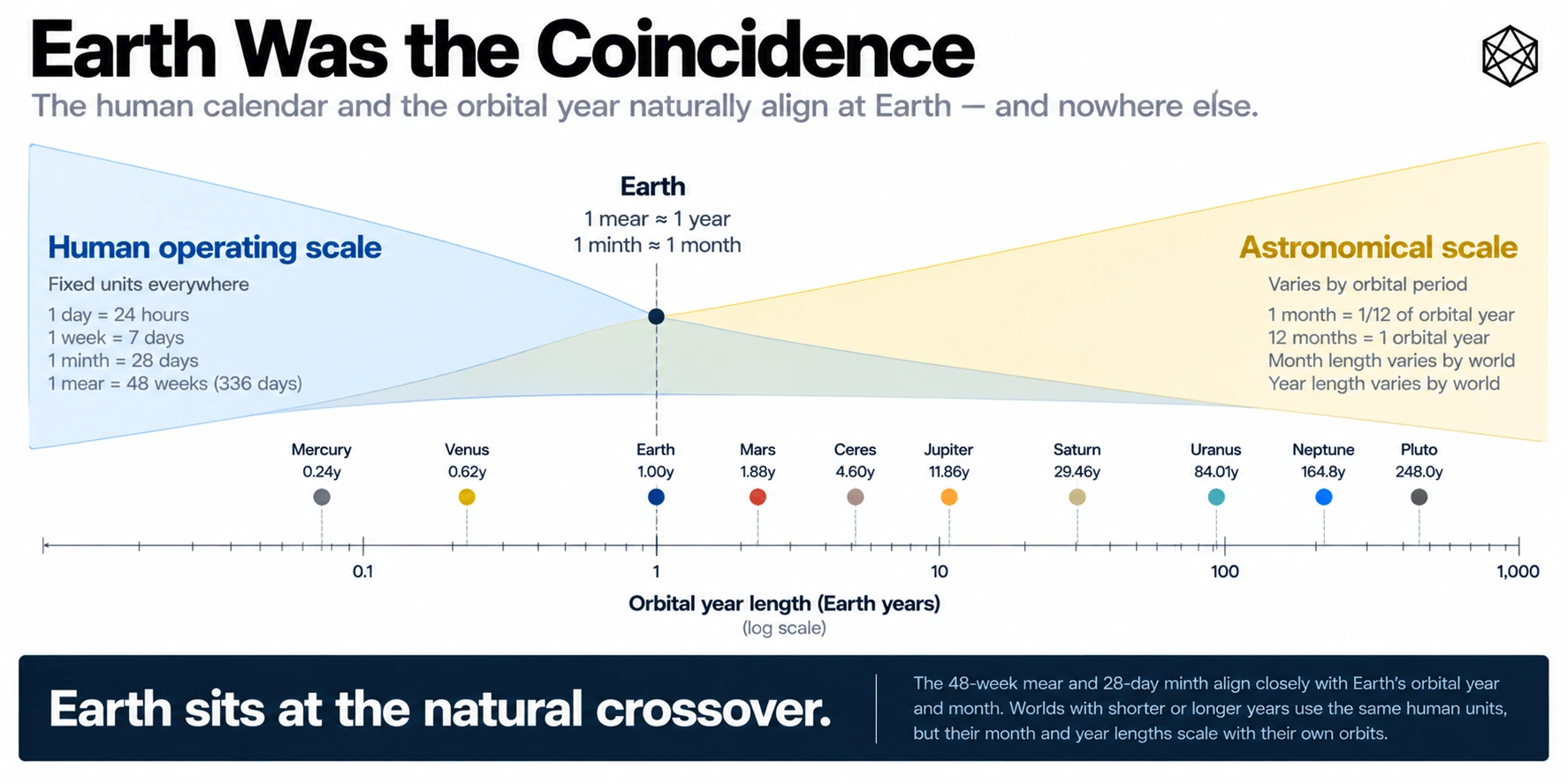
This gives us an interesting way to understand why Earth has been such a misleading starting point for interplanetary calendar design.
On most other worlds, Solarian begins with a portable human operating cadence and then asks how that cadence relates to the local astronomical year.
On Earth, those two scales nearly coincide.
The protocol collapses to R1.
One year contains one mear. One orbital month contains one minth.
The remaining engineering problem is simply how to represent a 52.18-week physical year using complete weeks.
The result is:
52-week Common Years
53-week Leap Years
12 complete minths
4- or 5-week minths
four 13-week Common-Year quarters
continuous weeks
fixed weekday boundaries
Under the design requirements of Solarian, there is not much room left for a radically different answer.
In that limited sense, the result is close to an Earth operating-calendar optimum.
Not optimal against every cultural, historical, religious or social objective a calendar might serve. Optimal against the specific design brief established in this book: human-scale operating regularity, whole-week structure and Solar-System interoperability.
That qualification matters.
This is not a campaign against Gregorian
None of this means Earth should replace the Gregorian calendar.
Calendars are infrastructure.
Gregorian is embedded in law, software, finance, religion, contracts, historical records and the habits of billions of people. Replacing it would impose enormous transition costs to solve problems that most people do not experience as sufficiently serious.
There is little value in solving a theoretical optimisation problem by creating a practical catastrophe.
So this is not a calendar-reform proposal.
Earth serves another purpose.
It is the control experiment.
Solarian was developed elsewhere and then brought home.
If that process had produced something bizarre for Earth — seventeen months, broken weeks or a human operating rhythm unlike anything people have ever found useful — that should have worried us.
It does not.
It produces R1.
R1 produces an ordinary 52-week year divided into four identical thirteen-week quarters, using twelve four- and five-week periods, with an occasional 53rd week to recover the astronomical remainder.
Human organisations have independently converged on closely related structures whenever operational consistency matters enough to justify stepping away from Gregorian month lengths.
That does not prove Solarian is the one true calendar.
There is no such thing.
But it is useful convergent evidence.
Solarian was developed to make time work across Mars, the giant planets, independent asteroids and artificial worlds. Only afterwards did we ask what it would have proposed for Earth.
The answer is rather satisfying:
It gives us, in essence, the calendar humans already reinvent when we design Earth time primarily for operations.
And that tells us something important before moving inward again.
Earth is the easy case because the human and astronomical calendars nearly coincide.
Venus is where they stop doing so.