REQUIREMENTS
3) What Must Be Shared
The Design Brief
We now know enough to stop talking about calendars in the abstract.
Imagine a mature but interconnected human civilisation spread across Earth, Mars, large asteroids, the major planetary systems and artificial habitats. Some settlements are old and culturally distinct, others remain closely tied to Earth, while people, organisations, contracts and records move between them.
The question is not whether each place can invent a calendar. Of course it can. The harder question is whether many different worlds can possess meaningful local civil time without losing the shared structure needed to remain one civilisation.
That is the design brief.
Before proposing an answer, it helps to define what such a system should actually be required to do. Otherwise calendar design becomes an exercise in admiring whichever arithmetic happens to look neatest.
Four tensions
Most of the problem can be reduced to four tensions.
The first is between human cadence and astronomy. A calendar should reflect the world people inhabit, but human beings still need recurring periods measured on human timescales even when the local orbital year lasts decades.
The second is between local identity and common structure. Mars should be allowed to become Martian, Titan Titanian and Ceres Cererian, without those places becoming temporally unintelligible to one another.
The third is between regularity and astronomical remainder. Rotations and orbits do not divide neatly into one another, so irregularity cannot be eliminated; it can only be placed.
The fourth is between generality and honesty. A multi-world architecture should work across very different environments, but it should also be able to admit when a particular world lies outside the range where its standard form works well.
Those tensions lead to ten requirements. None is especially difficult in isolation. The challenge is that several of them pull in opposite directions.
Requirement 1 — Human-scale cadence
A civil calendar must provide recurring intervals that remain useful to human beings and organisations regardless of the length of the local orbital year. That sounds obvious until we reach Saturn or Neptune. One-twelfth of Neptune's orbit may be astronomically meaningful, but it cannot be the only recurring interval available to a school, hospital or company.
The important word is recurring. A useful operating calendar gives people stable positions they can learn, anticipate and reuse. Ordinary life should not have to expand and contract simply because the local planet moves around the Sun at a different speed.
Requirement 2 — Local astronomical identity
The opposite requirement matters just as much. A permanent settlement should not need to abandon the physical world it inhabits in order to obtain a practical calendar. Mars has a real orbit, Ceres has a real orbit, while Titan and Enceladus travel around the Sun with Saturn; those cycles will shape local history, environment and eventually culture.
A local civil calendar should therefore retain a meaningful relationship with the destination's actual heliocentric year. That does not mean every environmental variable belongs in the calendar. Illumination, eclipses, radiation, moon phase and local seasons may need their own scientific or operational systems.
But the civil year should still belong to the world.
Requirement 3 — Common chronology
Local calendars do not remove the need for one shared historical timeline. A contract signed on Earth and completed on Mars must still be placeable unambiguously in common history. Scientific programmes, legal events, qualifications, travel records and interplanetary institutions all require a chronological reference that remains comparable across locations.
This is a different job from local civil time. A person living on Titan may reasonably use a Saturnian calendar to understand where their world is in its orbit while still recording an event against a common human chronology. A multi-world architecture should therefore allow local calendars and shared history to coexist rather than forcing one system to perform both functions.
Requirement 4 — Cross-world interoperability
Shared chronology solves only part of the coordination problem. People will still encounter local dates from other worlds. A traveller leaving Mars for Ceres, or an organisation operating simultaneously around Earth and Jupiter, should not have to learn an entirely unrelated temporal language at every destination.
The requirement is not identical calendars. That would sacrifice local astronomy and eventually local culture. What is needed is shared structural meaning: enough common grammar that different local calendars can be recognised, converted and understood as members of the same wider system.
A traveller should encounter local variation, not temporal amnesia.
Requirement 5 — Orbital legibility
A local year is more useful if its internal position says something about where the world actually is within its orbit. On Earth, January and July are not merely arbitrary counters. They provide low-resolution information about annual position; nobody uses them to navigate a spacecraft, but they remain meaningful astronomical labels.
The same should ideally remain true elsewhere. A civil calendar does not need to encode precise orbital mechanics and certainly should not replace an ephemeris. Its position within the year should simply retain a useful coarse relationship with local heliocentric phase.
That requirement matters because it creates the possibility of genuine failure. On sufficiently eccentric orbits, a regular civil subdivision may cease to represent orbital position well enough.
A credible architecture should be able to detect that.
Requirement 6 — Continuous weekly structure
The week deserves stronger protection than calendar designers sometimes give it (and I include myself in that feedback). It is not astronomical, but it is deeply embedded in work, education, religious observance, staffing, maintenance and family life. Breaking that sequence to repair an astronomical mismatch creates operational complexity far below the level at which the mismatch originated.
The preference should therefore be clear:
Calendar correction should occur in complete weekly blocks wherever practical.
That means no days sitting outside the week, no arbitrary weekday reset at New Year and no disappearing weekday identity introduced simply to make higher-level arithmetic look tidy. The calendar may need irregularity. The week should not have to absorb it.
Requirement 7 — Multi-scale scalability
A multi-world architecture should still look like itself as orbital years stretch. Mars, Ceres, Jupiter, Saturn, Uranus and Neptune operate across radically different timescales. A design that works brilliantly for a two-year orbit but requires an entirely different conceptual system at eighty years is not really one architecture.
The physical durations must change. The intellectual model should not. A person moving outward through the Solar System should encounter the same broad logic expressed at different scales rather than relearning what a calendar fundamentally is at every destination.
The system should stretch.
It should not mutate.
Requirement 8 — Bounded vocabulary
Scalability has a linguistic consequence. A long planetary year should not require an ever-expanding list of uniquely named short periods. Neptune should not need thousands of recurring labels merely because its orbit lasts 165 Earth years.
Human beings already know how to solve this problem. On Earth we reuse Monday every week and January every year. Context supplies the larger position. A scalable multi-world calendar should do the same. Its recurring human-scale vocabulary should remain compact and reusable even when the astronomical cycle becomes very long.
Duration may expand.
The dictionary should not.
Requirement 9 — Local cultural autonomy
A shared architecture should not attempt to design future culture from present-day Earth. Settlements will eventually create their own names, observances, holidays and traditions. Some may preserve strong cultural continuity with Earth, while others deliberately distinguish themselves.
That variation is not noise to be engineered away. It is part of what permanent settlement means. The technical architecture should therefore standardise only what interoperability actually requires. Machine-readable identities and conversion rules may need to be common; spoken names, holidays and local ceremony do not.
The calendar should separate protocol from culture.
That allows a settlement to belong locally without becoming incomprehensible externally.
Requirement 10 — Graceful failure
The final requirement is deliberately unfriendly to grand theories.
The standard design must be allowed to fail.
A supposedly universal calendar can always be made successful by relaxing its definitions whenever an awkward case appears. Add an exception here, move a threshold there, and eventually every world fits.
That is not generality. It is immunity from evidence.
A credible architecture should expose the conditions under which its standard form ceases to work properly. If an eccentric orbit makes a regular civil date a poor representation of orbital position, the system should say so rather than quietly redefining success.
A local or alternative implementation may then be needed. That is acceptable. Graceful failure is not the absence of failure. It is the ability of one part of a system to reach its limit without making everything else incoherent.
The brief in one table
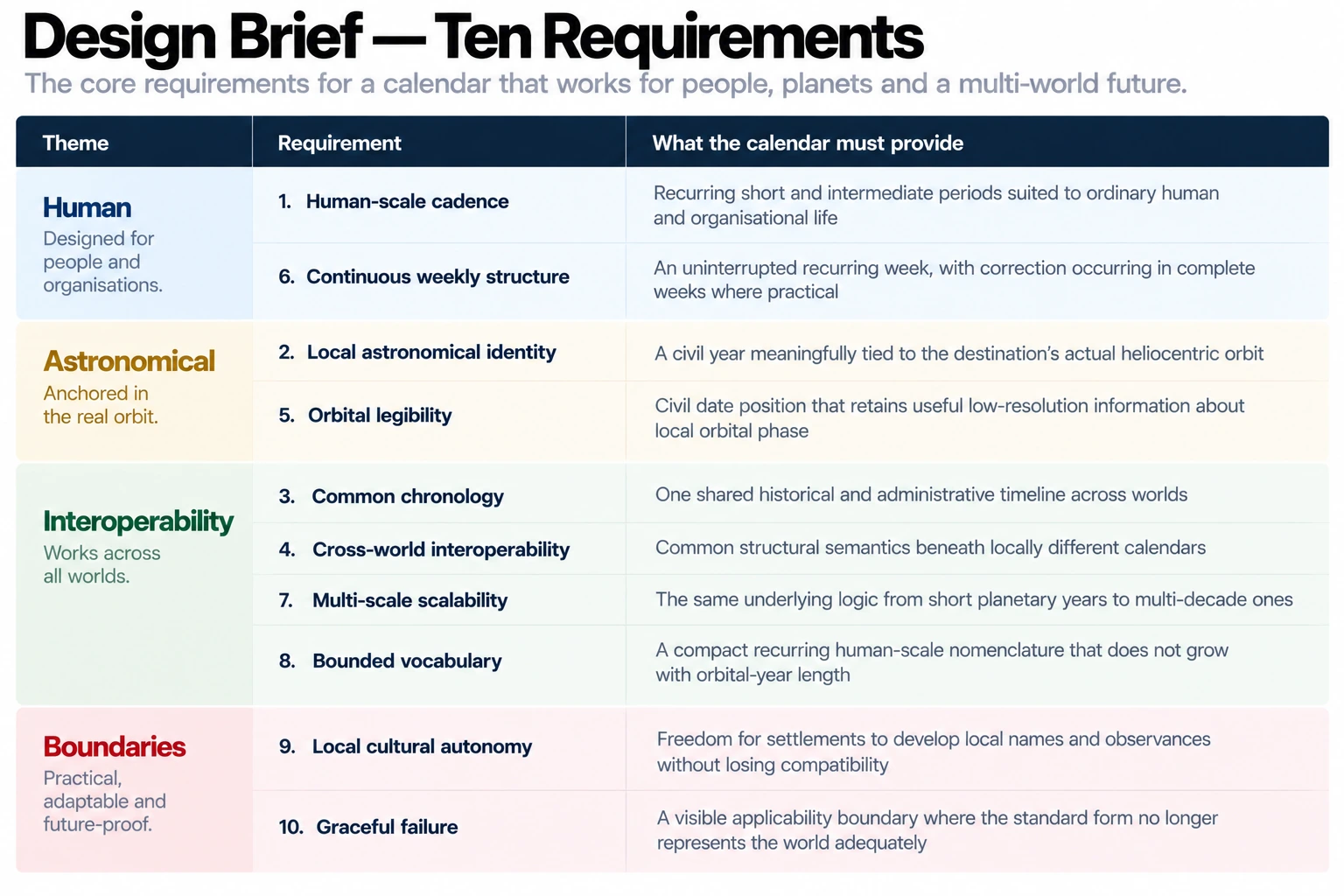
The ten requirements can be stated compactly.
| Requirement | What the calendar must provide |
|---|---|
| 1. Human-scale cadence | Recurring short and intermediate periods suited to ordinary human and organisational life |
| 2. Local astronomical identity | A civil year meaningfully tied to the destination's actual heliocentric orbit |
| 3. Common chronology | One shared historical and administrative timeline across worlds |
| 4. Cross-world interoperability | Common structural semantics beneath locally different calendars |
| 5. Orbital legibility | Civil date position that retains useful low-resolution information about local orbital phase |
| 6. Continuous weekly structure | An uninterrupted recurring week, with correction occurring in complete weeks where practical |
| 7. Multi-scale scalability | The same underlying logic from short planetary years to multi-decade ones |
| 8. Bounded vocabulary | A compact recurring human-scale nomenclature that does not grow with orbital-year length |
| 9. Local cultural autonomy | Freedom for settlements to develop local names and observances without losing compatibility |
| 10. Graceful failure | A visible applicability boundary where the standard form no longer represents the world adequately |
Individually, none of these requirements is particularly difficult. The difficulty is satisfying them together.
The requirements conflict
This is where the design brief becomes an architecture problem. Human cadence prefers stable, familiar durations, while astronomical identity prefers local physical cycles. Interoperability pushes towards common structure, cultural autonomy pushes towards local freedom, whole-week integrity constrains where correction can occur, and orbital legibility becomes harder as eccentricity increases.
Scalability adds another constraint: clever tricks that work beautifully on one world become liabilities if they collapse when the orbital period doubles. There is no reason to expect one arrangement to maximise all of these objectives at once. A choice that improves one can easily weaken another. More astronomical fidelity may reduce regularity. More universal structure may reduce local autonomy. More elegant arithmetic may make the system less useful to the people who actually have to live inside it.
Nor should we pretend that a neutral mathematical score can decide the matter. Assigning percentage weights to astronomical meaning, human convenience and cultural autonomy would produce an impressively precise answer to a largely invented equation. Some requirements can be tested mathematically. Others cannot.
We can calculate drift, orbital error and whether a week has been broken. We cannot calculate from first principles whether future inhabitants of Ceres will prefer a particular naming convention or whether organisations will find one planning cadence more intuitive than another. A serious design should distinguish those claims rather than blend them.
Distribute irregularity; preserve structure
Every calendar eventually meets the remainder. Earth's year is not an integer number of days, the lunar cycle does not divide cleanly into the solar year, and Mars does not provide an integer number of sols per orbit. Other worlds merely supply their own versions of the same inconvenient arithmetic.
The error cannot be abolished. It can only be located.
That leads to the central design principle of this chapter:
Distribute irregularity; preserve structure.
When correction is unavoidable, put it where it causes the least operational damage. Do not destabilise a frequently repeated human rhythm merely to make a larger astronomical unit perfectly uniform, and do not accumulate every correction into one grotesque exception if the difference can instead be distributed predictably.
The objective is not sameness.
It is predictability.
A calendar can tolerate some periods being longer than others if the variation is bounded, visible and understandable. Gregorian already does this with months and leap years. Regularity means knowing the rules. It does not mean pretending the astronomy has no remainder.
Astronomy constrains; civilisation designs
There is a broader principle behind all ten requirements. Astronomy tells us which physical cycles exist. It does not tell us how society should organise them.
A rotation period can be measured to extraordinary precision without answering whether people should use it as their civil day. An orbital year can be calculated perfectly without telling us whether organisations should budget around it or whether children should measure their age with it.
Those are civil decisions.
The opposite extreme is no better. Human convenience alone could produce a beautifully regular calendar that tells inhabitants almost nothing about the world they occupy. So the problem is not astronomy versus people.
It is deciding where each should govern.
That is the turn hidden inside the design brief. A successful multi-world calendar cannot simply choose the most astronomical answer or the most convenient human one. It needs an architecture that allows different functions to live at different scales without losing their relationship to one another.
That is why multi-world calendar design is an architecture problem rather than a numbering problem.
A specification, not a prophecy
These requirements are not laws of nature. They describe the kind of civilisation considered in this book: permanent but interconnected settlements that value local astronomical identity, shared chronology, human operating cadence and cross-world interoperability.
Another civilisation could make different choices. A strongly Earth-dependent outpost might use Gregorian alone, an isolated settlement might care very little about interoperability, while an artificial habitat might decide that heliocentric civil identity is irrelevant.
Those choices can be perfectly rational.
The purpose of a design brief is not to prove that its priorities are inevitable. It is to make them explicit. That allows the architecture that follows to be judged against a visible problem rather than admired merely because the arithmetic looks clever.
Now we can design
The first chapter established the setting: a future civilisation distributed across many worlds. The second showed that calendars have always been engineered compromises and that Earth's familiar hierarchy is an unusually convenient local arrangement rather than a universal law.
We now have the requirements for what comes next.
A Solar-System calendar architecture should preserve local astronomical identity without sacrificing human cadence. It should maintain common chronology and interoperability without erasing local culture, keep the week structurally intact, scale across radically different orbital periods, control its vocabulary and admit when its standard form has reached its limit.
Those requirements do not point naturally towards one conventional calendar hierarchy. They point towards separation of functions: deciding which structures should belong to human operating life, which should belong to local astronomy, and what minimum architecture is needed to connect them.
It must also accept one fact that calendar designers have been confronting for thousands of years:
Astronomical irregularity cannot be removed. It can only be managed.
That is the brief.
The next question is whether one coherent architecture can actually satisfy it.