PART III - THE PLANETS SLOW DOWN
Stress-Testing Solarian from Mars to Neptune
The Solarian Protocol is deliberately small.
On paper, it provides a human operating cadence, a local astronomical calendar, a way of connecting those scales where synchronization is useful, and a controlled mechanism for absorbing the inconvenient fractions produced by real orbits.
The more interesting question is what happens when we give it to actual worlds.
Part III moves outward through five increasingly demanding tests:
MARS — the first other world, where R2 keeps human and astronomical time relatively close.
JUPITER — a planetary system, where one calendar must belong to several possible inhabited worlds.
SATURN — a multi-decade year that turns out to fit the architecture almost perfectly.
URANUS — a generational year approaching the scale of a human lifetime.
NEPTUNE — a year longer than one, containing 179 complete human operating cycles.
The progression is deliberate.
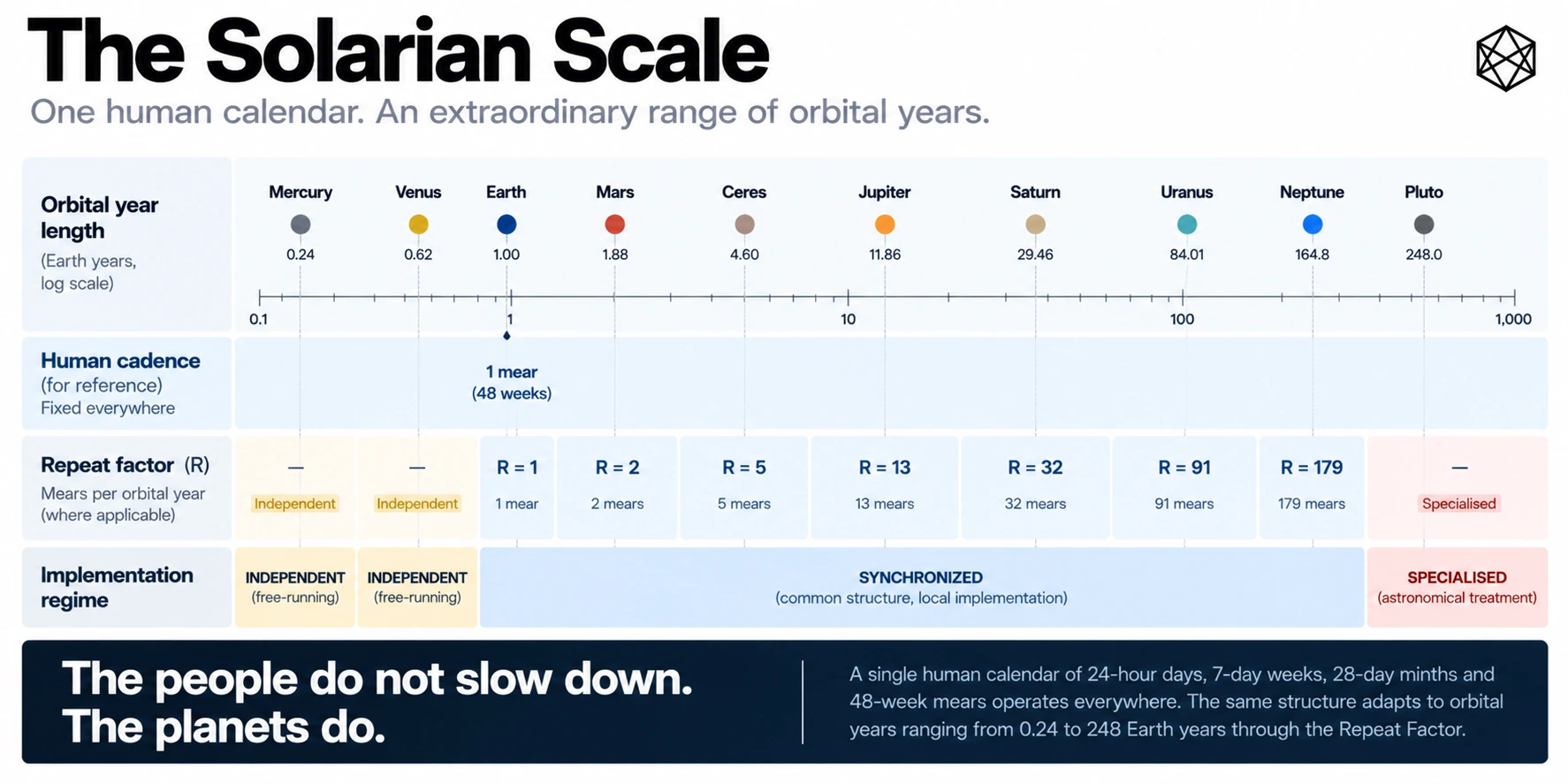
The Repeat Factors rise from R2 to R179. Orbital months grow from weeks and months of familiar scale into periods lasting years and eventually longer than childhood.
Yet the people do not slow down as we travel outward.
The planets do.
That is the test: whether the same human-scale calendar grammar can remain intelligible while the astronomical clock stretches by almost two orders of magnitude.
If it can, Solarian has begun to demonstrate that scale need not produce complexity.